The Pride. Michigan State is now the holder of the undisputed best quality win in the country. The Spartans held on at home to beat the Oregon Ducks 31-28. Heinemann hopeful Connor Cook threw for 192 yards with a touchdown and an interception. The Ducks had chances late but couldn’t convert. The Spartans now look like a worthy rival to defending national champion Ohio State.
The Shame. The bottom of every conference is filled with teams that are simply not good. The Big Ten had two teams lay embarrassing eggs. Fresh off a loss to Portland State, Washington State traveled cross country to beat Rutgers at home. Meanwhile down the road in Maryland the Terrapins were whipped by Bowling Green in a 48-21 home loss.
The Pride. After an opening weekend in which the conference posted a 12-1 record including a 4-0 mark against Power Five conference opponents, there is little to crow about in week 2. Ole Miss, Alabama and Texas A&M dominated outmatched and outclassed opponents, but when paycheck games are the height of your weekly accomplishments you know you’ve had a bad week.
The Shame. Where to start? Auburn slipped by Jacksonville State in overtime to avoid the biggest upsets since Stanford-Southern Cal. Arkansas State played a close game with Missouri and East Carolina kept the score close with Florida. As bad as those games were, the real shame goes to Arkansas who allowed Toledo to come to Little Rock and leave with a win. Continue reading →
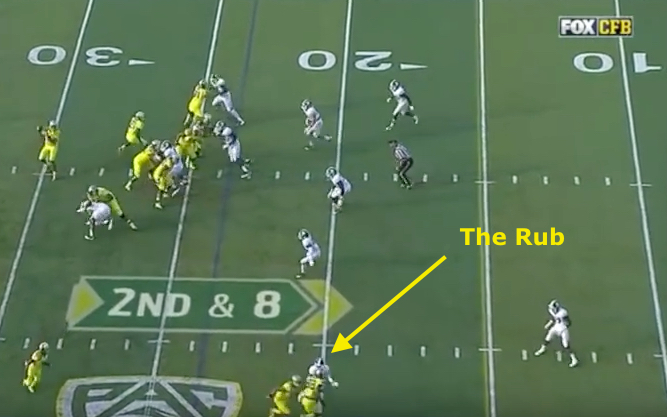
A combination of pass routes where one receiver’s route is designed to cause him to run into the defender guarding another receiver.
This is also called a pick play. There are two receivers in this combination. One is the player to whom the play is designed to go. The other receiver is essentially going to block the defender guarding the primary receiver. It is like setting a pick in basketball, hence the other name. Of course, blocking a defender in coverage or picking him is illegal since it is offensive pass interference. However, if a receiver happens to rub up against a defender while he is running his route, that typically won’t draw a flag.
Many coaches use rub routes or routes that will be very close to being rub routes depending on the coverage. Usually crossing patterns alone are not enough. The receivers must also have their timing down to increase the likelihood of making contact.
Screen Grab Credit: FOX
In 2014 Oregon sparked their comeback against Michigan State with a long touchdown pass in the 3rd quarter. The route in question, which is above, is a typical rub route.
Gridiron Glossary is a resource for football terms that are often used by commentators, coaches and players but rarely defined. If there is a term you have questions about or a definition you don’t agree with, let me know at billy@thirddowndraw.com.
The Gamecocks played from behind most of Thursday night. South Carolina took the lead for the first and only time against North Carolina on Shon Caron’s 48 yard touchdown run in the fourth quarter. Carson scored on a play Steve Spurrier referred to as a handoff sweep in his post game comments. In a night in which the Gamecocks attempted all kinds of run plays to keep the offense moving, it was this play that proved the most effective down the stretch.
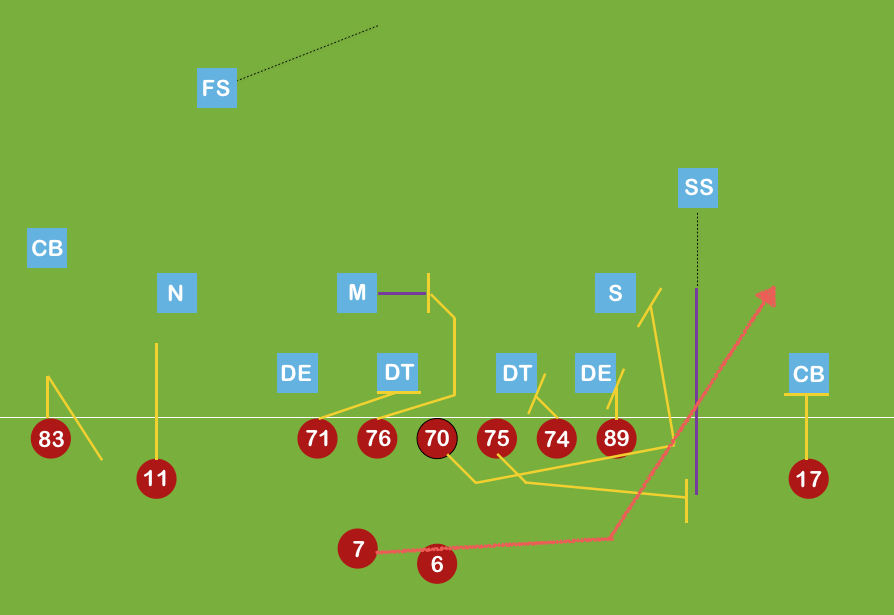
How the Handoff Sweep Works
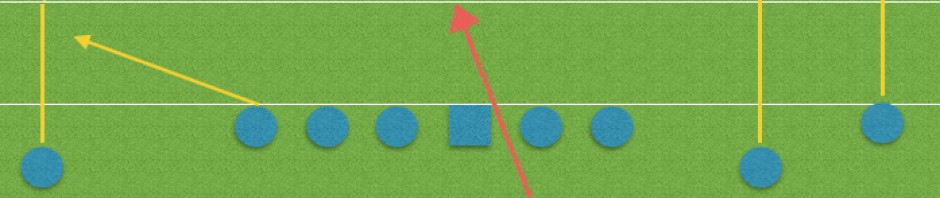
The Line. On the play the center and the play side guard pull around to lead the running back to the edge. When an offensive lineman pulls he doesn’t go forward to block someone. Instead he steps back into the backfield and then runs down the line of scrimmage to find someone to block.
South Carolina’s handoff sweep has the play side guard lead the center to the outside. The guard’s responsibility is to kick out the first defender who appears, meaning he is to block him toward the sideline. The center then leads through the hole and seals any flowing linebackers who are scraping to the play.
Scraping defenders are players pursuing the running back by moving at an angle down the line of scrimmage toward the ball carrier. The center wants to ‘seal’ him inside so he cannot make the tackle.
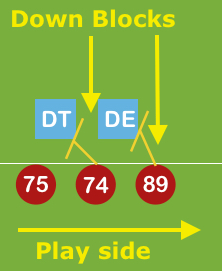
Because the center and guard are pulling someone has to block the defenders in front of them. Here the play side tackle and tight end both block down, meaning they each block the defenders to the inside of them.
On the backside of the line, the guard steps play side to make sure the backside defensive tackle doesn’t shoot the gap, then he proceeds to the linebacker. If the backside defensive tackle tries to follow the pulling center into the backfield, the guard has to block him. The backside offensive tackle tries to block the defensive tackle, if he can get there, and if not goes for the Mike (middle) linebacker. Between the two backside offensive lineman, they will block the defensive tackle and the Mike linebacker.
The Receivers. The receivers do a combination of things to help the play. On the back side one receiver runs a hitch pattern and the other sets up to block the closest defender in coverage. This should occupy the defenders in coverage. If the defenders don’t respect these routes, the play call can be changed to throw the ball to them.
On the play side, the wide receiver stalk blocks the corner covering him. The stalk block is a technique where the receiver leaves the line of scrimmage like he is going to be running a pass route. In addition to making the defender think he is trying to run a pattern the receiver is also getting a good angle between the defender and then run. Then, when the defender realizes it is a run and turns to run up to make a tackle, the receiver then starts to block him.
Screen Grab Credit: ESPN
Backfield. In the backfield the quarterback takes the snap from shotgun. The running back is set up to the backside and comes across the quarterback’s face (in front of him). The quarterback gives the ball on a handoff, but he can just as easily run another variation of the play where he fakes the handoff and runs the other way. This possibility of a fake is why the backside defensive end isn’t blocked. He has to wait to make sure the quarterback didn’t keep the ball before chasing the running back.
Shon Carson’s Touchdown
On Shon Carson’s touchdown this all set up perfectly. With Pharoh Cooper to the top of the formation in the slot, the free safety’s attention was over there. The free safety actually lined up on top of Cooper but then moved to the middle of the field for the Cover One Man coverage they were running. (The pre-snap movements are dotted lines on the diagram of the play below.)
When the free safety moved to the middle of the field, the strong safety moved up in line with the linebackers to help support the run. At the snap the strong safety moved into the backfield either because he read the run coming to his side or because he was on a run blitz. He was too wide to effectively stop the run and was easily blocked by right guard Will Sport.
Center Alan Knott then turned up field to seal off the linebackers coming from the inside. The Sam linebacker, who stood and watched the beginning of the play, was the first player. When the linebacker starts to move to try to tackle Carson, Knott is there to block him.
All of the down blocks were effective, and Mike Matulis, the left guard, was able to get to the Mike (middle) linebacker and stop him from flowing to the ball. Carlton Heard blocked the corner beautifully, and Carson was off to the races.
Why Not Every Time?
The handoff sweep was run about a half dozen times through out the game, but it only went for long yardage this once. The reasons why it was so successful were actually a combination of factors.
The North Carolina defense was in a call that benefitted the play. The defensive line was slanting to the weak side, meaning at the snap all of the lineman were attacking the gap to their right. Since South Carolina was trying to down block the two play side defensive lineman, this helped. It also allowed the back side guard, Matulis, to get to the Mike linebacker.
Two Tarheel players were slightly late and out of position to help spring the big play. The Sam linebacker spent the beginning part of the play watching the backfield. As a result he was slow in getting to the line of scrimmage to stop the run. This set up Alan Knott’s block on him. Similarly, the strong safety rushed into the backfield too far outside. Once Will Sport engaged him, Shon Carson had plenty of room to stay at full speed through the hole.
All of these factors were aided by the fact that none of the Carolina players missed a block or was beaten on a block. This was exactly the way the play was drawn up and why it was so successful. Other times in the game the Tarheels were in better position, both because of the defense they happened to be running and better plays by their players, which is why those situations gained 8-10 yards instead of 48.
More of This
This play will certainly remain a part of the South Carolina play book. It can be run from the wildcat with Pharaoh Cooper or Brandon Wilds taking the direct snap just as easily as it can be run with Connor Mitch in shotgun.
There are atlas three variations on the play which will probably be run throughout the season. First, the quarterback can keep the ball and run around the opposite end on a read option if the defensive end is disciplined. Second the quarterback can throw the hitch to the top of the play. Third, the offensive lineman can pull to give the same look, but pass block on the edge, and the quarterback can fake to the running back and throw deep. Expect to see some or all of these variations at some point.
You don’t want to have to throw a Hail Mary pass. In fact, calling a Hail Mary means that literally everything else in your playbook is useless at this point, and you might as well just throw the ball up and pray (hence the name). You are out of time and still trailing. You have to score now. You are too far away for any of your regular plays. Even in this moment of desperation there are some things that can be done to make the Hail Mary a little more likely to be answered.
Get close enough. Most teams don’t have a quarterback who can throw the ball the length of the field. Some can throw around 70 yards, but 60 yards of distance is a safe bet for a college quarterback. To get the ball to the end zone, you are going to need to be around your own 40, and the closer you get the better your chances are. Continue reading →
The last marquee match up of opening weekend kicks off Monday night in Blacksburg when Ohio State tries to avenge last season’s loss to Virginia Tech. After last season’s surprising upset both teams’ seasons moved in opposite directions. The Buckeyes ran the table, won the Big Ten and then the national championship. Virginia Tech lost to East Carolina and finished the regular season 6-6.
The oddsmakers don’t think a repeat is likely. Ohio State is favored by somewhere around 14 points, depending on which sports book you are looking at. Even considering the Ohio State suspensions, including all-everything defensive end Joey Bosa, the odds are long for the Hokies.
Last season’s upset came on the back of the Virginia Tech defense. The defense held the Buckeyes to 21 points and had the pick 6 at the end of the game to ice the win. If Virginia Tech is going to stay in the game again, they will need a similar defensive effort.
Double Eagle Defense
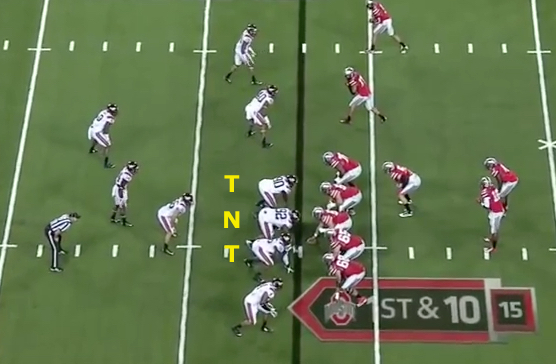
Last year the Hokies moved into a double eagle front frequently, and it was effective in stopping the Ohio State interior running game. The double eagle is a defensive formation where the nose guard plays over the center and each defensive tackle plays over each guard. It is sometimes called a TNT defense because when it is diagramed, ‘TNT’ is spelled out because of the close proximity of the tackle, nose and tackle.
An offensive formation where the quarterback is directly behind the center, but neither under center nor as deep as a shotgun position with a running back directly behind him.
Credit: ESPN
The key to the pistol is not the position of the quarterback; it is the position of the tailback. When executing a running play out of the shotgun the tailback is usually running laterally to the line of scrimmage when he gets the ball. The pistol allows the exact same play to be called with the running back receiving the ball while running toward the line of scrimmage.
Gridiron Glossary is a resource for football terms that are often used by commentators, coaches and players but rarely defined. If there is a term you have questions about or a definition you don’t agree with, let me know at billy@thirddowndraw.com.
The slot is the position of a backfield receiver about halfway between the offensive line and a split end. It can denote both the player and the position on the field.
Credit: ESPN
A player can be the slot or can be in the slot. Sometimes the term is used to describe simply the inside receiver in a twins grouping. Typically slot receivers are covered by linebackers or safeties who tend to be less adept at coverage than cornerbacks.
Gridiron Glossary is a resource for football terms that are often used by commentators, coaches and players but rarely defined. If there is a term you have questions about or a definition you don’t agree with, let me know at billy@thirddowndraw.com.
2015 should be the year North Carolina takes their big step forward. The first three seasons of the Larry Fedora project have been average to slightly above average, not exactly what Bubba Cunningham envisioned for his football program.
Fedora was brought in to win games. After the success he had at
Photo Credit: GoHeels.com
Southern Miss it seemed that the combination of UNC’s resources, the fertile recruiting ground of the state of North Carolina, a down ACC and Fedora’s offensive mind would lead to sustained success. It hasn’t happened yet.
2015
This is the season when it all could come together. Fedora is in his fourth season; the schedule couldn’t be much more favorable, and the amount of returning offensive talent is the envy of the conference. Continue reading →
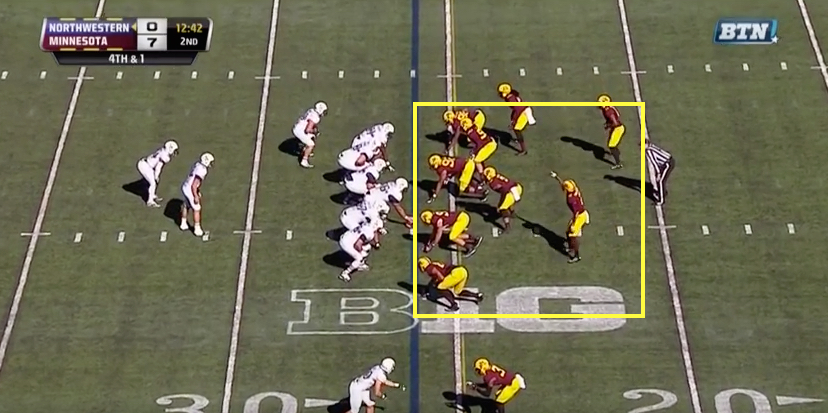
The box is the area on the defensive side of the ball close to the line of scrimmage directly across from the offensive line.
Credit: BTN
The box is usually about as wide as a tight end would be and about as deep as five yards. The number of defenders in the box is typically an indicator of how committed the defense is to stopping the run on that play. Many offenses count the numbers in the box and make calls based on whether those numbers are favorable for running or not.
Gridiron Glossary is a resource for football terms that are often used by commentators, coaches and players but rarely defined. If there is a term you have questions about or a definition you don’t agree with, let me know at billy@thirddowndraw.com.
The flat or the flats (there is one on either side of the field) is the shallow area of the field beyond the line of scrimmage.
Credit: FS1
Sometimes it is defined as being outside of the hashmarks, but it is more properly identified as being outside of the normal defensive formation. On the screenshot above the flat is closer than the hashmarks at the top of the frame but further out on the bottom of the frame.
Gridiron Glossary is a resource for football terms that are often used by commentators, coaches and players but rarely defined. If there is a term you have questions about or a definition you don’t agree with, let me know at billy@thirddowndraw.com.








 Third Down Draw