
Big XII Expansion: Coming this Summer?

logo-2Yesterday, Oklahoma President David Boren told The Oklahoman’s Berry Tramel that a decision on expansion for the Big XII conference would come this summer.

After being the victim of expansion by the Big Ten, SEC and Pac-12, the Big XII’s future has been debated.  One school of thought has held that the Big XII needed to expand to 12 teams so it could hold a football championship game.  The championship game itself would bring in more money, and the teams playing in the game would have a better chance to play in the playoff, which would add more money.

The importance of the 11th and 12th teams for a championship game has been diminished with the NCAA’s ruling that 12 teams are no longer a requirement for a championship game.  That ruling seemingly ended serious speculation about the Big XII adding schools, but yesterday’s announcement rekindled the possibility of new teams coming to the conference.

Why? Money.  All conference expansion is about money.  It is either about creating new revenue streams or protecting current streams.  The Big Ten and SEC had the same model: create a larger footprint in order to sell a conference network.  The ACC expanded for a different rationale: stability and protecting the strength of the league.

The Big XII would seem to be more akin to the ACC.  It doesn’t have a conference network that would benefit from a large footprint, and the existence of the Longhorn Network all but precludes the possibility of a network in the future.  Any conference expansion would need to provide more money or protect the existing money.  Without an obvious new source of cash it would seem that stability is the goal.

Who? The American Athletic Conference or a few others.  In the American conference there are Cincinnati, who Oklahoma would support, UConn, who has wanted back in a major conference since the dissolution of the last incarnation of the Big East, and SMU, a school who once had the biggest of big time football.  Schools like Memphis, Houston, Central Florida and East Carolina all harbor aspirations of upward mobility.  Outside the conference Boise State and BYU are often floated as possibilities.

Defend?  It has long been speculated that 16 teams is a natural size for a conference.  The ACC sits at 14 or 15, depending not he sport.  The Big Ten and SEC each have 14.  The Pac-12 has … twelve.  If any of these last three conferences decided to expand the Big XII could be a target.  Geographically it is the only conference that makes sense for the Pac-12 to target, and it is contiguous with the SEC and Big Ten.  Adding teams could be

Expand?  On balance there isn’t a mandate to expand.  There’s no slam dunk candidate who would bring in a great deal more money.  There are schools who fit, but is the expansion going to bring long term stability?  That’s the question.  Apparently we’ll have an answer this summer.

Posted in Uncategorized | Tagged , , , , , , , , , , , , | Comments Off on Big XII Expansion: Coming this Summer?

Valentine’s Day Rivalry

Most people aren’t thinking about college football on Valentine’s Day.  Usually it is just another day with no football and no recruiting.  Florida State did not want to let the day pass without reminding the Gators of last season’s loss.

FSU Valentines

That’s some quality trolling form FSU’s official twitter account.  If you look closely you may notice that the tweet was sent out at 1:33 pm or exactly 27 to 2.

This is how rivalries should be done.

(H/T Reddit CFB)

Posted in Uncategorized | Tagged , , , | Comments Off on Valentine’s Day Rivalry

Parity isn’t coming soon

One of the (many) reasons I don’t like the NFL as much as I like the college game is because of the parity.  In the NFL there is no such thing as a great team nor is there such thing as a terrible team.  There are 32 teams composed of great players running similar schemes.  The difference between a playoff team and a middle of the pack team is miniscule.

Why is this a problem?  It’s a problem for me because there are no upsets.  There are no Stanford beating Southern Cal as 40 point underdogs.  Boston College can’t knock off mighty Miami.  There aren’t 20 point underdogs winning because there are no 20 point underdogs.  A two touchdown line is large by NFL standards.

The college game has resisted that rush to the center.  There are still great teams, terrible teams and everything in between.  There are upsets and blowouts.  You don’t know what you are going to get.  It appears that is going to continue (which is great news if you are a college football fan).

In an article on SB Nation Kevin Trahan points out that the rich are getting richer in terms of quality recruiting.  It’s no surprise that great players want to play with other great players.  Without a draft and salary cap, there’s no way to prevent large groups of talented individuals congregating in, say, Tuscaloosa or Columbus.

Trahan has some nice graphs showing just how much separation there is in each conference.  Here’s what he has to say about Alabama:

It’s not just the West that’s fallen behind entire teams in recruiting. Alabama is better than three entire divisions. The Crimson Tide’s class would rank just ahead of the Pac-12 North’s all-star class and far ahead of the all-star classes for the ACC Coastal and the Big Ten West.

The whole article is worth a read.

Posted in News | Tagged , | Comments Off on Parity isn’t coming soon

Signing Day FAQs

Today is signing day?  Yes, today is signing day.  For college football it is always the first Wednesday in February.

Is today the only day to sign?  No.  Today is the first day to sign a national letter of intent.  Players can, but rarely do, sign later in the process.

Does an athlete have to sign?  No.  A player can sign and most do, but if he is accepted to a school he can enroll like any other student.  This is more common with junior college players.

Why sign?  After a player signs with a school the rules for contact with the coaches change.  This allows the coaches to talk with the player a great deal more.

How many players can my school sign?  It depends.  There is a limit of 85 scholarship players that can play football.  Your school can sign however many spaces they have.  If your team had 85 players on scholarship and 20 graduated, they could sign 20, but it’s usually more complicated than that.

How?  First, players leave for a variety of reasons.  Graduation, injury and academic ineligibility are common.  It’s not uncommon for the number of available scholarships to exceed 25.  This can be an issue for a school because the school can only offer 25 new scholarships a signing period.

So my school can only sign 25?  No, 28 is the actual limit on the number of players who can “sign”.  25 of which can actually receive scholarships.

Then 3 players sign but don’t get scholarships?  Usually not.  In most cases some of the kids who sign won’t qualify and will have to go to prep school or junior college.  Since they don’t enter college on scholarship with the rest of the class they don’t receive a scholarship and count toward the limit of 25.

But I’ve seen schools sign more than 28.  How do they do that?  A few ways.  The most common way is a mid year enrollee.  Some students graduate from high school in December and start college in January.  In certain situations those students can count back toward the last season’s limit not toward the 25 limit.  As the saying goes, the numbers tend to work themselves out.

OK, what about ratings?  Most services rank the prospects using a star system.  5 stars is the most and is rare.  4 stars is next, and represents a very good player.  3 stars is next.  These are solid, major college prospects.  2 stars are projects who may take years to contribute.  No one usually gets a one star in major college football.

Do ratings matter?  Only if you care about winning.

But, one of my favorite players was a 2 star and the 5 star stunk.  Yes, there are busts and diamonds in the rough, but they are the exception rather than the rule.

My team is going to have a great signing day.  We’re going to be good right?  Maybe.  To be good a team MUST have talent, but that talent has to work hard and be coached well to develop.  The difference in a talented high school senior and a well coached, hard working, talented college football star is great.

Are these guys getting paid to sign?  Not officially, no.  Unofficially, I don’t think so either. But if you want to know about how it can work, read Steven Godfrey’s article.  How often does it work like that?  Rarely?  Usually?  I have no idea.  I think it if it was really common we’d hear about it more often.

Should I tweet at recruits? No.

But what if I have something important to say? NO.

What if?  Signing day is fun.  The stars of tomorrow are committing to school and for many fans it’s a great day.  For players, it’s about choosing their college, choosing where they are going to go to school for the next 3-5 years.  They are making a big life decision.  As happy or disappointed as you may be about a particular recruit the impact on your life in tiny compared to theirs.  This is about them, not us.  Don’t tweet at recruits.

Posted in News, Uncategorized | Tagged | Comments Off on Signing Day FAQs

Recruiting Rankings Matter

“Never make excuses.  Your friends don’t need them, and your foes won’t believe them.”

— John Wooden

Tomorrow is national signing day, the day when a select few high school seniors sign binding agreements to accept scholarships to play college football.  For some the decision has been made and is public.  Their day will only be a formality, a confirmation of the known.  For other prospects tomorrow holds intrigue.  Where will they sign?  Will it be this school or that?

It’s an exciting day.  The stars of the future (and the busts) commit to their schools.  Coaches and fans know which players are theirs and can begin to pin hopes to the incoming talent.  Every coach will speak highly of his class.  They will say that they are excited about the players, that they have a lot of upside and that the class meets the teams needs.

Signing Day is an Old American Tradition

Signing Day is an Old American Tradition

Sometimes that will be true; most of the time it will not be.  On signing day there are winners and losers.  There are teams who really do get the players they wanted and meet the needs they perceive.  Other teams miss on their most coveted prospects.  They take project players in positions of dire need.  They lose on signing day.

There will be spin from the coaches and fans, and it will inevitably include a bald face lie: recruiting rankings don’t matter.  Major networks make a living evaluating players and singing classes.  They rate them and then rate the classes has a whole and rank both.  At the end of the day we will know who has signed the best class.  Those who haven’t will tell us recruiting rankings don’t matter.

It may not matter if you finish 6th in recruiting instead of 5th.  It matters a great deal if you finish 36th instead of 5th.  Recruiting rankings are a measure talent, and talent matters.  Talent is almost always the difference between winning and losing.  No scheme, no coaching, no pre-game speech matters as much as talent on the field.  Talent alone is not enough, but try winning without it.

It’s true that recruiting is an exercise in evaluation and projection, both of which are inexact sciences, but every year the recruiting services get better.  They have more film on more prospects; they are more experienced.  They know what a five star bust looks like as well as a two star diamond.  They, as evaluators, are more experienced, and there are more of them.  Their rankings are a more accurate representation of talent every year.

If your signing class isn’t as good as you’d hope, it’s not the end of the world.  It’s not the end of the program.  Some of those players may indeed outperform expectations.  Some will make big, memorable plays.  Comfort yourself with that, but don’t delude yourself into thinking your class is different, your coaching staff is different.  Everyone got it wrong except you.  Don’t allow yourself to believe it.  You know it’s not true, and you’re only setting yourself up for the disappointment that will come when your class performs as projected.  At that point the loss on signing day will manifest itself into losses on the field.  Recruiting rankings will matter a great deal then.

Posted in Opinion | Tagged | Comments Off on Recruiting Rankings Matter

(Belated) Thoughts on the National Championship

2000px-Clemson_University_Tiger_Paw_logo.svgDeshaun Watson is Amazing.  Alabama won the game, but this was my biggest takeaway from the game.  I spend most of the season watching him play well thinking, “yeah, he’s good,” but I don’t think Clemson would have been in the game without him.  They wouldn’t have made it to the national championship game without him.  He is that important to that team, and Clemson is a team filled with NFL talent.  The Tigers would probably have won 10 or 11 games with a good, but not great, quarterback.  That’s the difference Watson made.  Because of Watson Clemson was in the game in the sense that they had a chance to win.  How much did Watson matter, well…

Alabama stopped Clemson?  Bear with me for a minute because this isn’t going to sound quite right, but Alabama stopped Clemson’s offense.  Now, that’s not exactly right.  Clemson put up over 500 yards of offense and 40 points; that’s not stopped.  What Alabama did do is take away the basics of the Clemson offense.  The Tigers like to put pressure on the edge.  They didn’t really have success then.  Then they like to run inside.  That wasn’t very successful at all.  Then they go deep.

The Tide took away Clemson’s first two options most of the night.  On many of pass plays receivers were covered.  So, if Alabama stopped all these Clemson offensive tactics, how did the Tigers put up 40 points and 500 yards?  Deshaun Watson.  How many times did he drop back to pass, find his receivers covered and run for a first down?  How many times on third down?  How many passes did he complete to receivers that were pretty covered?  His value cannot be overstated.

Clemson stopped Alabama?  The Tigers committed to stopping the run.  They held Heisman winner Derrick Henry to 158 yards.  That doesn’t sound good, but it was only 4.4 yard per carry, much less than he was used to this season.  There was a price to stopping Henry though.  That price was OJ Howard.  The talented, but little used tight end was wide open most of the night, and he piled up 200+ yards receiving.  It seemed that Clemson’s defenders played run first and, somehow, when they transitioned into pass coverage missed the tight end.  That was a difference in the game.

Coker.  Speaking of differences in the game, look at Jake Coker.  In the first half he 31VN9nWog2L._SY355_refused to step up in the pocket and held the ball way too long en route to several sacks.  The Clemson pass rush was potent, but Coker helped by not throwing the ball away when he could.  In the second half he made fewer mistakes and torched the defense to the tune of 335 yards.
The Alabama Slow Bleed.  Across the board Alabama is the most talented team in the country nearly every year, and they play a style of football designed to make that talent differential come to bear.  They play strong, suffocating defense that usually breaks opposing offenses.  Clemson’s never really broke, a credit to the Tigers.

The Alabama offense just leans on you.  They run the ball with zone and power looks and throw off of it.  Their players, the line in particular, are so talented that you have to be at your best to keep up with them.  Clemson did that, for a while.  Then as often happens, when the game gets late, players get worn down.  They get out of position.  They try to compensate for the talent gap and become schematically unsound.  OJ Howard is then wide open on the post.  They try to crash inside to stop the run, and then they miss a tackle on the edge.  Another Howard big gain.  Usually it happens early in the second half, like it did against Michigan State.  Clemson didn’t let it happen until late in the fourth quarter.  Unfortunately for them, it did end up happening, and that was the difference.

Posted in News, Opinion | Tagged , , , , , | Comments Off on (Belated) Thoughts on the National Championship

The Most Important Play of the National Championship

There is one play, more than any other, whose success will affect the outcome of the national championship game.  The play is a designed run for Deshaun Watson, the quarterback power.

Clemson’s offense works off a relatively simple formula: outside, inside, deep.  They spread the field with their formations.  If the defense doesn’t commit adequate defenders to the receivers on the outside, Clemson attacks the edge.  The simplest way to do this is to throw a hitch to a receiver.  They also use jet sweeps and tunnel screens often.

Jet sweep is the play where a receiver from one side sprints across the formation.  The ball is snapped and either handed or tossed to the receiver as the passes the quarterback.  The receiver, now the ball carrier, runs to the outside to turn up field.  The tunnel screen is a screen pass in which a receiver from the outside comes back toward the middle of the field.  The offensive lineman release both down field and to the outside to block.  It sometimes looks like the receiver us running through a tunnel.

If the defense adjusts to the outside plays, usually by placing more defenders outside, Clemson will then try to attack the middle of the field with their running game.  Despite being a “spread” offense, Clemson’s running game borrowers heavily from archetypal power running teams.  They do run a zone read, and they couple it with sweeps and powers.  The most important play they run is the quarterback power.  (If the defense tries to adjust to this play, Clemson will throw intermediate and deep.)

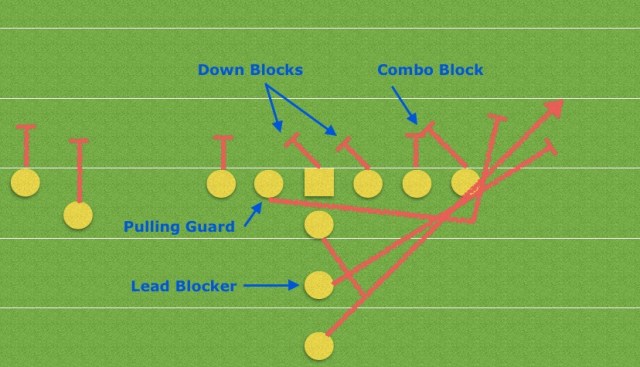
For a refresher, here is the typical, off tackle power, as run out of the I formation.

I form Power

The elements of the power are:

  • Combo Block at the Point of Attack
  • Down Blocks
  • Lead Blocker
  • Pulling guard

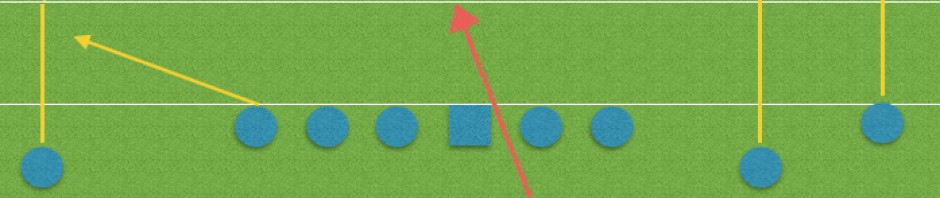
Notice the quarterback just hands the ball off and gets out of the way.  Other than the threat of a bootleg or play action pass, he is no longer part of the play.  That leaves 9 blockers for one ball carrier.  Look at one of Clemson’s power variations.  (They run a few).  Here’s how they did it against North Carolina.

Clemson Power 1

Look familiar?  Combo block at the point of attack, pulling back side guard, additional lead blocker …  They key improvement over the traditional power is that the quarterback is running the ball.  That also Clemson to spread the field and still create a numerical advantage at the point of attack.  Here’s another variation on this theme.

Notice there are some differences on this variation.

Clemson Power 2

The center pulls, rather than the backside guard, and there is an H back who leads the play as well.  There are three blockers leading Watson.  The play is designed to go off tackle, but on this particular one, there were too many bodies inside, so Watson bounced it outside, something he does often.

Why is this play so important?  It’s important because this, and other power plays, are what the Tigers are going to turn to if Alabama either takes away the quick passing game or over commits to it.  If Clemson is consistently successful with this, their offense will have an advantage over the Crimson Tide.  On the other hand, if Alabama can stop this, especially out of a base set, then the Tiger offense will become much less effective.

Posted in News, Schemes | Tagged , , , , | Comments Off on The Most Important Play of the National Championship

Post Hoc, Ergo …

c01-sline-logo-30_001-4_3Monday night’s winner of the Clemson – Alabama game will be the undisputed national champion of college football.  That team will be the winner of a four team playoff which is part of a system that every FBS conference and team bought into and participated in.  Gone are the days of split national championships or of systems where not all teams and conferences participated.

The playoff provides one national champion culled from the ranks of four contenders.  Lost in the praise for the system is the fallibility inherent in having a playoff of only four teams.

Four teams is a drastic improvement over the two team playoff that existed under the BCS, but four is an arbitrary number.  In any given season there aren’t only four teams who are capable of winning two games against the best teams in the nation.  Last year TCU blasted #9 Ole Miss in the Peach Bowl 42-3.  Does anyone doubt TCU could have won two games if given the chance?

The Horned Frogs were famously and controversially denied that chance in favor of Big Ten champion Ohio State.  The Buckeyes wen on to win two games and the national championship.  The ‘controversy’ over OSU’s inclusion in the playoff died down among simplistic arguments of “see they belong; they won it”.  Those arguments simplified the issue then and didn’t address the issue of whether Ohio State deserved to be there.

Put another way, just because a team wins a game or two in the playoff doesn’t mean that team should have been in the playoff.  There are more than four teams capable of winning those games; that doesn’t mean those teams should be in there, but we should acknowledge the possibility that teams capable of winning the playoff were left out.  Teams like TCU last season or perhaps Stanford and Ohio State this year.

There’s only room for four, and this year was a pretty easy year for the committee.  Clemson and Alabama were no-brainer inclusions.  Oklahoma and Michigan State, as major conference champions with only one loss, were the right decision to.  All other contenders either weren’t major college champions or had two losses.  The committee chose correctly this year.

However there’s no getting around the fact that there are other teams in college football who would have been capable of winning the playoff.  That doesn’t and shouldn’t diminish the legitimacy of the national championship game.  The winner will be the undisputed national champion with no asterisks, explanations or equivocations.  And in making absolute declarations of the supremacy of the Tide or Tigers we should remember that just because one of those teams does win it doesn’t mean that others couldn’t.

So, what does this mean?  Again, it doesn’t mean that the national champion isn’t that; it means that the playoff itself didn’t include everyone who could win.  Some people think that means the playoff should be expanded, perhaps to 6 or 8 teams.  Most people are fine with the four team playoff, and that’s fine.  The playoff leaves out teams who could be the best in favor of putting in the four teams who are the most deserving.  Reasonable minds differ about which is right and whether it is important.  What should be a given when debating the playoff and the conclusions that can be drawn from it is that there are other great teams out there who could win the playoff was well.

Posted in Opinion | Tagged , , , , | Comments Off on Post Hoc, Ergo …

Paper Tigers No More

You can’t doubt Clemson now.  The playoff win over Oklahoma is unequivocal.  The Sooners are a good football team, and the Tigers beat them, convincingly.  Going into the game you can be forgiven if you were skeptical of the ACC champs.

Unsponsored_Orange_Bowl_logo

Their resume had two or three good wins and a zero in the loss column.  For many the zero was more important than anything else, but that analysis is incomplete.  The strong wins were over Florida State, Notre Dame and possibly North Carolina.  The Tarheels were beaten soundly by a Baylor team who didn’t have a quarterback and couldn’t throw the ball.  Florida State lost to the AAC champs, badly.  Notre Dame hadn’t played yet, but when they did, they were blasted by Ohio State.

Clemson’s schedule only told us so much.  It told us they were consistent; it told us they were good, but it didn’t tell us how good.  We found out how good on New Year’s eve: very good.

The Offense

Clemson put up 37 points in a national semi-final game with a combination of spread tactics and power fundamentals.  That’s really how their offense works, especially this year.  The basic idea of the spread is to force the defense to defend the entire field, from sideline to sideline.  Clemson spreads the field with their formations and their play calls.  They often line up with four receivers and will throw hitches, screens and quick, horizontal passes.  They will run jet sweeps and shovel passes to get the ball to the outside.  They will put pressure on the edges of a defense.

Defenses adjust to what Clemson is doing.  Oklahoma did.  They adjust by defending the flats and the sidelines. When they do that Clemson usually has a numbers advantage in the box.  That’s when they go to their power offense.  People don’t usually think power offense when they see the Tigers line up with receivers all over the field, but that’s what they are doing.

2000px-Clemson_University_Tiger_Paw_logo.svgThe one factor that makes this Clemson offense special is Deshaun Watson.  Although he is a good passer, he is most effective running the ball.  There are essentially three plays he shreds defenses with, and they are all predicated on the defense worrying about defending the entirety of the field.  Those three plays are the power, sweep and zone read.  Those are the plays the Tigers ran the most against the Sooners, and as the game wore on, Oklahoma wore down.

In a nutshell, that’s the Clemson offense.  Put pressure on the outside of the field.  When the defense adjusts to the outside, run power plays inside.  If the defense tries to pull defenders up to help defend the entire line of scrimmage, Clemson’s receivers go deep.  It’s a nightmare to defend, as Oklahoma now knows.

The Defense

Clemson’s defense was equally dominant allowing on 17 points.  How they did that was much simpler.  They dominated the line of scrimmage.  All the Xs and Os in the world cannot overcome an offensive line getting handled by a defensive line.  The Orange Bowl was the latest reminder that if the d line dominates, the game is over.  That’s what Clemson did.

The Tigers also took away Oklahoma’s x factor, Baker Mayfield.  This is the luxury of having talented players.  In order to pressure the passer Clemson didn’t have to take men out of coverage to blitz.  They didn’t have to sacrifice rushing lanes to get pressure, they were often able to get pressure with four defenders, and they rushed in a way that kept Mayfield in the pocket.  He was rarely able to slip out of the pocket, and his game was much less effective without that ability.

One More

We now know Clemson is one of the best teams in the nation.  Next Monday we’ll know for sure if they are the best.  A win over Alabama in the national championship game would be absolute.  There would be no wiggle room or argument.  They would be 15-0, playoff champions and the only undefeated team in the country.  They certainly don’t resemble paper tigers anymore.

Posted in News, Schemes | Tagged , , , | Comments Off on Paper Tigers No More

Orange Bowl

Clemson plays Oklahoma in the Orange Bowl, part of the college football playoff.  The Sooners are currently 3.5 point favorites to win the game.

Advantage Clemson?

Teams don’t always play the same in bowl games as they played at the end of the season.  It is the only time in the season where there is a long layoff between games.  Some teams use that time to fine tune their attack and fix issues they are having.  Other teams get rusty and have trouble getting started in the bowl game.  In this game the break might be an advantage for Clemson.

At the end of the season the Sooners were playing their best football, and Clemson was surviving.  The Tigers continued to win, but they weren’t playing as well as they had earlier in the schedule.  They didn’t cover the spread in their last four regular season games and were -5 in turnover margin during their last four games overall.  They played much better earlier in the season.

Oklahoma, on the other hand, was playing its best football at the end of the year.  In consecutive weeks they beat Baylor, TCU and Oklahoma State, two of those games on the road.  The offense was clicking on all cylinders.  They may be able to play just as well, but it would a mistake to assume they will.

Beating Oklahoma

Oklahoma has been beaten once this season in the Red River Rivalry against Texas.  After that game, I explained how Texas used the quarterback power repeatedly to beat the Sooners.  Here’s that article to refresh your memory.

Clemson runs the quarterback power with Deshaun Watson, himself a very capable runner.  They also like to use similar principles to get Watson to the edge on quarterback sweeps.  Here is Watson’s first touchdown against South Carolina with the quarterback power.

Clemson will definitely run this play, and they will utilize several formations to give different looks.  The more early success they have with this the better their offense will be.  If Oklahoma has to commit extra defenders to the box to stop the run, passing lanes will open down field.  Clemson’s scheme works well to pass off this play since Watson can just roll the pocket and find a receiver coming across the field.

Texas Power 1

A Texas version of the Power

If, on the other hand, Oklahoma can take away this play without brining safeties down to help, that will slow down Clemson’s offense considerably.

Beating Clemson

The key to stopping Clemson’s offense is no secret: you have to stop Deshaun Watson.  Watson throws the ball well and runs well, too.  Lots of quarterbacks can do that.  What makes Watson such a problem for the Sooners and what makes the Tiger offense so effective is Watson’s tendency to pull the ball down and run on pass plays.

Many times this season Clemson has been facing a key down and called a pass play.  The defense has been ready, has the receivers covered and is close to putting pressure on Watson.  Then he pulls the ball down, escapes the pocket and picks up whatever yards the Tigers need.  He’s done this repeatedly, and it’s an important aspect of their offense.  Can Oklahoma stop it?

Well, how do you stop this?  Generally there are three ways.  The Sooners will have to use some of all three.  First, they can get to Watson before he has a chance to run.  To do this they will probably have to bring a blitz, which they can’t rely on the whole game.  Second, their defensive line has to rush with discipline.  They can’t get too far upfield or get trapped inside.  They have to keep Watson in the pocket.  Third, and least desirable, Oklahoma can put a spy on Watson.

A spy is a defender, usually a linebacker, whose job is to wait for the quarterback to run and then keep him from doing so.  It can be effective if the defender is an excellent athlete and open field tackler.  it’s not very desirable because they spy is neither rushing the passer nor being effective in pass coverage, but if the alternative is the quarterback scrambling for first downs, there may not be a choice.

Transitive Property

Clemson and Oklahoma haven’t played any common opponents, so if you want to look at schedules and make wildly insignificant inferences, you can.  Three such inferences jump to mind.

The Baylor-North Carolina data.  Oklahoma beat Baylor by 10 who beat North Carolina by 11.  Clemson just beat North Carolina by 8.  10+11-8.  Oklahoma will win by 13.

The Tennessee-South Carolina data.  Oklahoma beat Tennessee by 7.  Tennessee beat South Carolina by 3.  Clemson beat South Carolina by 5.  7+3-5.  Oklahoma will win by 5.

The Notre Dame-Texas data.  Clemson beat Notre Dame by 2.  Notre Dame beat Texas by 35.  Texas beat Oklahoma by 7.  2+35+7+44.  Clemson will clearly win by 44.

Blowout?

Every offense plays better when it can be balanced.  Both of these offenses are explosive and have a habit of building big leads early.  When they do that the game can look like an avalanche.  The opposing team becomes one dimensional trying to throw to get back in the game and becomes less effective.  The Tigers or Sooners are then able to get quick stops and score some more.  The results are games that are over before half time.  That probably won’t happen here, but with these offenses, it could.

Posted in News, Opinion, Schemes | Tagged , , , , , | 1 Comment