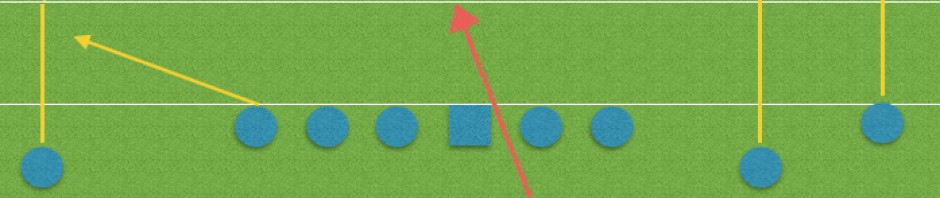
Key Plays: The Texas Power

On Saturday Texas shocked Oklahoma to win the Red River Rivalry.  The Longhorns, 1-4 entering the game, weren’t supposed to be able to compete with the 4-0 Sooners, but Texas took an early 14-0 lead and held on at the end to win.

During the game the announcers gushed over the offensive game that Jay Norvell called.  His play calling was innovative and confusing making good use of misdirection.  They were partially right.  Norvell called a great game, and he obviously had his offense prepared, but the bread and butter for the Longhorns was the quarterback power.

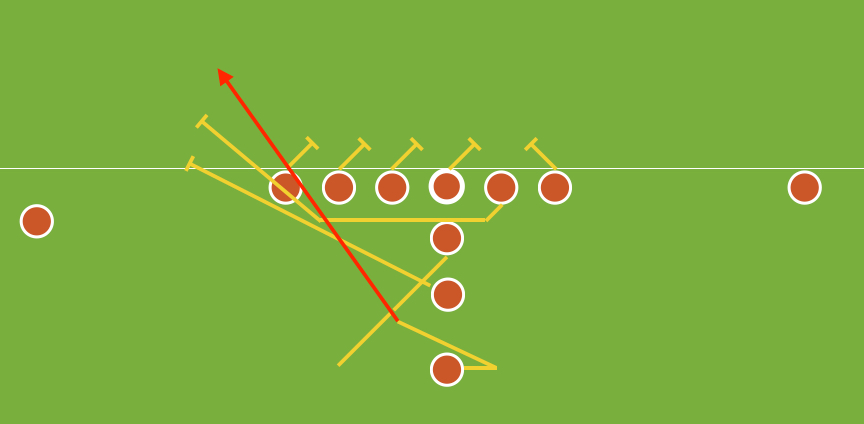
Traditionally the power is run out of the I-formation and looks like this:
Power

The offensive linemen on the play side of the formation, left side in the diagram, down block.  This means they block the lineman in front of them or to the back side, right in this diagram.  The back side guard pulls through the backfield to block the first person he sees.  The full back also goes to the same area to block the first man he sees.  The quarterback gives to the tailback who follows his blockers through the hole.

Ideally the hole will be created by the lineman pushing everyone to the inside, and the pulling guard and full back pushing everyone outside.  It’s an old play and one commonly run.  On Saturday Texas used some updated versions.  Here’s one of the updated versions.

Texas Power 1

From the shotgun with an H back on the back side, it’s the same play up front.  Look at the offensive line; all of the play side linemen down block, and the back side guard pulls to lead the play.  Instead of using the full back as the second kick out blocker, Texas used the H back from the back side.  Instead of handing the ball to the tailback, the quarterback keeps it himself.  And, in an additional wrinkle, the tailback is fakes a read option going the other way.  The read option is certainly a variation that can be added onto this play. Continue reading

Posted in Concepts, News, Schemes | Tagged , , , | Comments Off on Key Plays: The Texas Power

What We Learned: Week 6

Dabo is sensitive about Clemsoning.  Clemson beat unranked Georgia Tech 43-24 Saturday.  Had they lost the game, it would have been classic Clemsoning, but they didn’t.  A reporter asked Coach Swinney after the game about Clemsoning.  He wanted to know if the team was focused on one game at a time or do they not even think about it.  Dabo ranted.

He called it “that word”.  He repeatedly called it “bull crap” and implied that it was nothing more than a media construct.  Swinney found it ridiculous that he was even asked the question.  You should watch it if you haven’t seen it.

Dabo used to be better with the media.  Remember when Todd Ellis, the Gamecock play by play announcer, said that South Carolina sure isn’t Clemson after USC beat them?  Dabo then had someone ask him about it after practice (mis-attributing it to Steve Spurrier), and he ranted.  It was great use of media.  The story after the ball game was South Carolina beat Clemson convincingly.  After Dabo was through with it, the story was Clemson may have lost, but look at that program.  For whatever else that rant was, it was smart.

2000px-Clemson_University_Tiger_Paw_logo.svgThis rant doesn’t appear so smart.  Perhaps it’s because it wasn’t scripted or perhaps it was just venting, but it wasn’t wise.  First, Dabo made a bigger deal out of the question than he should have.  A simple, it’s important to focus on all games, every week or you’ll lose would have probably ended a non-story.  Second, it’s a gamble.  If Clemson loses to an unranked opponent this year or in a game where they are favored the term will come up again, along with the rest.  Dabo should prepare to go undefeated against unranked teams or for follow up questions. Continue reading

Posted in News, Opinion | Tagged , , , , , , , , , , , , | Comments Off on What We Learned: Week 6

Gridiron Glossary: Cushion

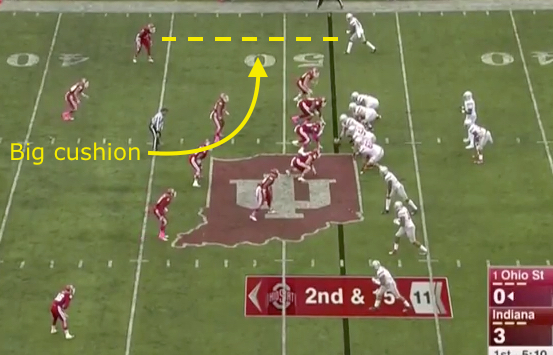
Cushion is the amount of space a defensive back puts between himself and the receiver.

Screen Grab Credit: ESPN

Screen Grab Credit: ESPN

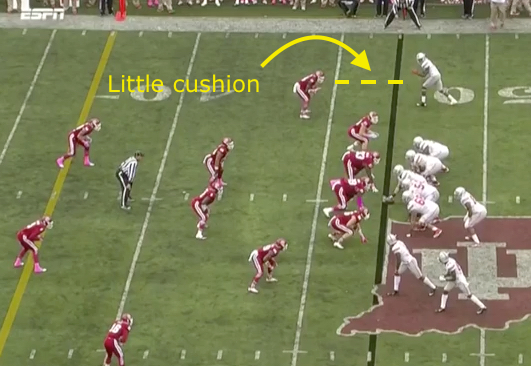
Cushion is easiest to see at the beginning of the play, but the term also describes the room that a receiver is given during the play as well.  It is a relative term in that there is either very little cushion being given or there is a lot of it.

Above is a lot of cushion; here is the opposite: very little.

Little Cushion

Screen Grab Credit: ESPN

Giving cushion or not is a tactical choice and is not right or wrong.  The advantage to giving the receiver cushion is that it is harder for the receiver to run by the defender or get to the deep part of the field, making big gains less likely.  The disadvantage is that it is more difficult to defend short, quick passes.

Giving less cushion is better for defending quick passes, but it has the trade off of making it more likely the receiver can get deep or break a big play.

Defensive philosophy, situation and defense all influence how much cushion is given.  For instance in a Cover 3 defense a cornerback may have responsibility for covering a deep zone.  It would make sense for that corner to give the receiver some cushion so that he can get to his zone before a receiver does.

Situations where the offense has fewer yards to gain usually dictate less cushion.  On 3rd and 3, it is inadvisable for the defender to be 10 yards off the ball.

Defensive philosophy also plays a role.  Defenses that want to be aggressive often provide little cushion, while those that are more cautious and concerned about denying the big play may give more cushion.


Gridiron Glossary is a resource for football terms that are often used by commentators, coaches and players but rarely defined.  If there is a term you have questions about or a definition you don’t agree with, let me know at billy@thirddowndraw.com.

Posted in Concepts, Glossary | Tagged , , , , , | Comments Off on Gridiron Glossary: Cushion

The Pride and The Shame: Week 6

b1g

The Pride.  Michigan certainly looks different with Jim Harbaugh, don’t they?  The Wolverines weren’t supposed to be ranked this year; it was supposed to be the beginning of a rebuilding process.  Now Michigan is sky rocketing up the polls behind a defense that refuses to yield points and a Utah loss that is looking more respectable by the day.  This week Michigan annihilated Northwestern, which sounds like to good ole days, but was in fact a quality win against a good opponent.

The Shame. It’s tough to call out one team for shaming the conference when all of the teams are playing each other.  However, a top 15 team shouldn’t get blown out by anyone, and they shouldn’t get shut out at all.  Northwestern, ascendant in the conference no more than a week ago, was blasted by Michigan.  The Wildcats managed 38 yards on 25 carries to go with 130 yards passing on 33 attempts, less than 4 yards an attempt.

TpSKg_3L

The Pride.  Leonard Fournette.  The LSU superstar didn’t make it to 50 yards in the first half against South Carolina, but he made up for it in the second half and finished with 158 yards on 20 carries.  That’s not why he’s here though.  He’s also gone over 1,000 yards rushing for the season in five games, but that’s not why either.  After the game Fournette read remarks he had prepared supporting the victims of flooding in South Carolina.  He then announced he would be auctioning off his jersey and donating the proceeds to the same flood victims.  Although usually such a gesture wouldn’t be tolerated by he NCAA, they have made an exception here.

The Shame.  South Carolina.  The Gamecock defense actually played well for times in this game, and at times some Gamecock players showed real fight, but at the end of the day it was another big defeat, this week by 21.  After the game Steve Spurrier wasn’t witty, wasn’t angry, wasn’t anything other than sad, which is appropriate given the state of his program.  Next week’s game against Vanderbilt could very well determine if the Gamecocks’ season is just bad or becomes an unmitigated disaster. Continue reading

Posted in News, Opinion | Tagged , , , , , , , , , , , , , , , | Comments Off on The Pride and The Shame: Week 6

Gridiron Glossary: Numbered Personnel Groupings

A two digit numbering system for identifying the offensive skill players on the field at a given time.

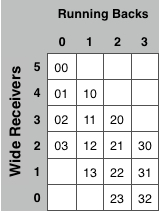
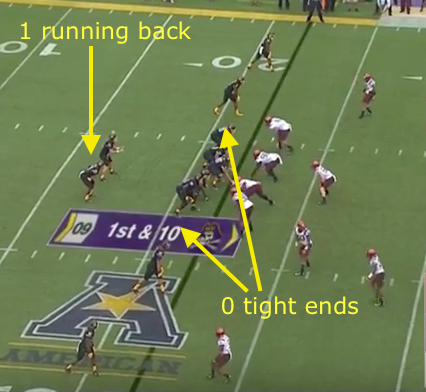
Personnel ChartThe numbered personnel grouping system is used by coaches and players but rarely by commentators and fans.  The system makes some assumptions in order to describe the players on the field simply and quickly. The two assumptions are that there is a quarterback and five interior offensive lineman.

Given those assumptions there are five additional players for which to be accounted.  Those players can be in the backfield behind the line, running backs.  They can be blockers adjacent to the interior line, tight ends, or they can be split out wide as receivers, whether on the line or off.

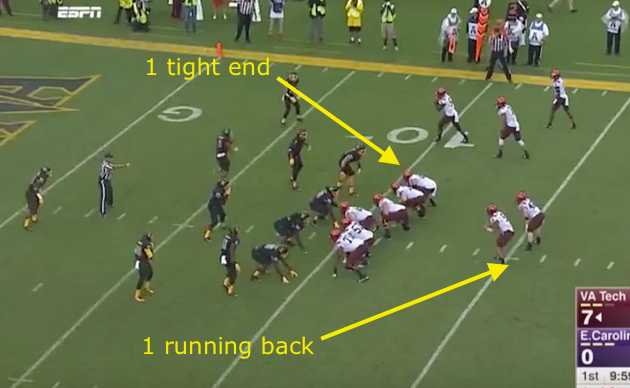
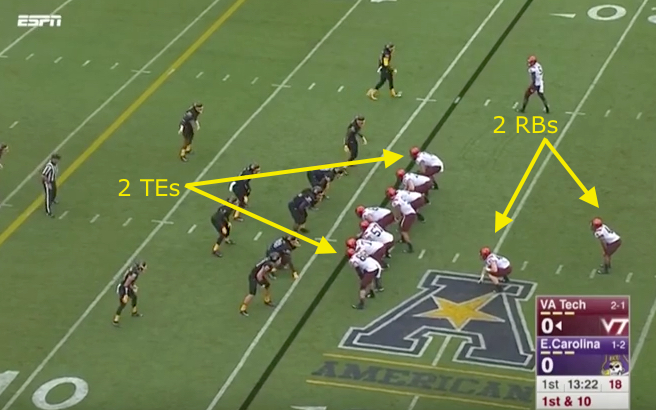
The first digit explains how many running backs are in the formation; the second digit explains how many tight ends are in the formation.  The receivers are not a part of the equation; they are what is left after subtracting the running backs and tight ends from five.

Sometimes it is easier to think of this system in terms of examples.  To begin with, if there is one running back and zero tight ends, the number would be 10, called ten personnel.

Screen Grab Credit: ESPN

Screen Grab Credit: ESPN

Here is a formation with 11 personnel, meaning one running back and one tight end.

Screen Grab Credit: ESPN

Screen Grab Credit: ESPN

Here is 20, two running backs and no tight ends.

Screen Grab Credit: ESPN

Screen Grab Credit: ESPN

This is a 22 personnel grouping, two running backs and two tight ends.

Screen Grab Credit: ESPN

Screen Grab Credit: ESPN

The personnel numbering system doesn’t tell you what the formation is, but it tells you what players are on the field.  Many different formations can be run from the same personnel groupings.

It tells the defense if the offense is going to be in position to run the ball or throw the ball and allows them to substitute to match.  For instance, if the offense has 32 personnel (3 running backs, 2 tight ends) coming on to the field, the defense will want lots of defensive linemen and linebackers to counter, but if the offense has 00 personnel on the field (0 running backs, 0 tight ends, 5 wide receivers), the defense will want lots of defensive backs to cover them.


Gridiron Glossary is a resource for football terms that are often used by commentators, coaches and players but rarely defined.  If there is a term you have questions about or a definition you don’t agree with, let me know at billy@thirddowndraw.com.

Posted in Concepts, Glossary | Tagged | Comments Off on Gridiron Glossary: Numbered Personnel Groupings

Gridiron Glossary: Fold Block

A fold block is specific blocking technique where two offensive linemen block two defenders by crossing paths with one another.

Fold Block

Almost always one offensive lineman will have a defender in front of him and an adjacent lineman will not.  The lineman with the defender in front of him is said to be covered; the other lineman is uncovered.  The uncovered lineman will first block the defender covering the other lineman.  The covered lineman will step behind and around the offensive lineman and block a defender further off the ball, usually a linebacker.

A fold block creates advantageous blocking angles for the lineman.  The first lineman to block is hitting a defender from the side, which makes his block easier.  The second lineman then moves around his teammate to get a better angle on another defender.


Gridiron Glossary is a resource for football terms that are often used by commentators, coaches and players but rarely defined.  If there is a term you have questions about or a definition you don’t agree with, let me know at billy@thirddowndraw.com.

Posted in Concepts, Glossary | Tagged , , , | Comments Off on Gridiron Glossary: Fold Block

Gridiron Glossary: Sluggo

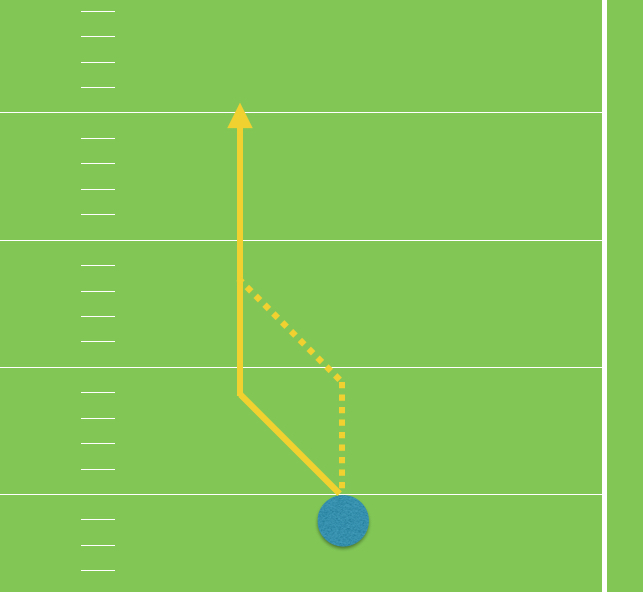
Sometimes called a slant and go, sluggo is a pass pattern where the receiver runs a slant and then breaks vertically up the field.

Sluggo

The route can be run with a quick slant or a standard slant.  In practice the slant portion of the route tends to be short because once the defense has reacted to it the receiver wants to make his second cut to gain separation.  The route is effective for getting a receiver into the seam and beating man coverage.


Gridiron Glossary is a resource for football terms that are often used by commentators, coaches and players but rarely defined.  If there is a term you have questions about or a definition you don’t agree with, let me know at billy@thirddowndraw.com.

Posted in Concepts, Glossary | Tagged , , , | Comments Off on Gridiron Glossary: Sluggo

Alabama Holds Key to Georgia’s Rise

There’s no disputing Georgia’s place among the blue bloods of College Football.  They 2000px-UGA_logo.svghave the tradition: a national title and a Heisman trophy.  They have the fanbase, and they’ve been quite good for many, many years now.  They are clearly a Top 20 program, but they aren’t elite.

There are only a few programs who have made it to the top, winning major conference titles and playing for National Championships.  Alabama is elite, Auburn, too.  LSU, Florida, Ohio State, Florida State and Oregon are all on the list.  Georgia is not.

For all of the success under Mark Richt the Bulldogs haven’t played for a national championship.  They haven’t won the SEC in 10 years.  Make no mistake; they are a very good program, but for some reason or another they’ve never been able to make the leap to elite.

The Gatekeepers

During the recent rein of the SEC, and for most of Nick Saban’s tenure in Tuscaloosa, Alabama has been the class of the conference and the nation.  They won three titles in four years and played for another in the playoff last season.  For another SEC team to join the ranks of the Elite, you have to go through Alabama.   Continue reading

Posted in News, Opinion | Tagged , , , , | Comments Off on Alabama Holds Key to Georgia’s Rise

Gridiron Glossary: Slant Route

A slant route is a pass pattern where the receiver runs at a 45 degree angle toward the middle of the field either from his starting position or after proceeding downfield a few yards.

Slants

The point of the route is to take advantage of a defender playing with outside leverage (physically preventing the receiver from breaking outside).  It is a quick play and one of the easier throws for a quarterback.  The pattern must be quick or inside players, like linebackers, can potentially get into the passing lane to disrupt the play.

It is difficult to defend once the receiver has successfully made his break, so one way of stopping it is to disrupt the timing of the pattern by playing press coverage.  Inside leverage (lining up inside the receiver) can be effective in taking the route away as well.

A slant route which is run without first proceeding vertically down the field is sometimes referred to as a quick slant.


Gridiron Glossary is a resource for football terms that are often used by commentators, coaches and players but rarely defined.  If there is a term you have questions about or a definition you don’t agree with, let me know at billy@thirddowndraw.com.

Posted in Concepts, Glossary | Tagged , | Comments Off on Gridiron Glossary: Slant Route

Gridiron Glossary: High Hat

High Hat is a term for the position of an offensive lineman’s helmet at the start of a passing play.

Many defenses use keys for their players to be able to quickly determine if the play is

Not this kind of high hat

Not this kind of high hat

a pass or a run.  A common key is for a defender to watch the helmet of a particular offensive lineman.  If the lineman fires off the ball, he is probably run blocking for a running play.  If the lineman stands up he is probably pass blocking.  These keys can be simplified into watching the helmet.  If the helmet is up or high, it is said to be a high hat to indicate pass.  Conversely a low hat indicates run.


Gridiron Glossary is a resource for football terms that are often used by commentators, coaches and players but rarely defined.  If there is a term you have questions about or a definition you don’t agree with, let me know at billy@thirddowndraw.com.

Posted in Concepts, Glossary | Tagged , , | Comments Off on Gridiron Glossary: High Hat