Bielema was (Almost) Right

Bret Bielema “got his ass kicked twice in a row” according to Texas Tech coach Kliff Kingsbury. Kingsbury apparently took umbrage with some comments that were attributed to Bielema in the off season. Bielema reportedly stated that “if you don’t throw to the fullback, we’ll kick your ass”, and “if you throw 70 times a game, we’ll kick your ass”. Kingsbury took the comments personally, apparently.

2015-05-27_05-36-18-PMArkansas-Razorback-LogoThe specifics of Bielema’s comments may not be commonly held beliefs, but the idea that there is a right way and a wrong way is very common among coaches. Some, like Bielema, will state on the record that if you do X or if you don’t do X, you’re going to lose.

College football is great for many reasons. One of the reasons is the variety of offensive schemes and defenses that are on display. There are hundreds of coaches and coordinators who all believe that their system is the right system, which is good. They should believe that. They shouldn’t be running a system they don’t think gives them the best chance to win. But they shouldn’t discount other ways of doing things. Continue reading

Posted in News, Opinion | Tagged , , , | Comments Off on Bielema was (Almost) Right

The Pride and The Shame: Week 3

b1g

The Pride.  Northwestern.  There isn’t a lot of chest thumping from the Big Ten this week.  Ohio State and Minnesota survived scares against lesser opponents, and many of the other teams played uninteresting games as well.  In the high profile games against the ACC, the Big Ten finished 2-3.  The best win was almost Nebraska over Miami, but that comeback was quashed in overtimes.

Either Iowa’s win over Pitt or Northwestern’s win over Duke is the apex of Big Ten pride this week.  Northwestern, now 3-0 and climbing in the polls, went on the road to defeat a respectable Duke team.  This game wasn’t high on the national radar, but it is a solid win that will age well.

The Shame. You could point to aforementioned close wins against bad competition, but winning, even ugly, is no cause for shame.  Being pantsed in Chapel Hill is another thing.  Illinois actually scored a late touchdown to make this game look better.  48-14 shouldn’t happen to teams with pride.

TpSKg_3L

The Pride.  Ummm.  There was only one out of conference game against another Power Five conference (see below).  There isn’t a lot of glory in beating the likes of Northwestern State, Austin Peay or UConn, but since UConn is the highest profile of the out of conference foes, congrats Missouri; you’re the pride of the conference this week.

The Shame.  Arkansas.  Last week’s loss was supposed to be an aberration;  the Red Raiders were supposed to get the wrath of the Hogs.  This didn’t go as planned.  In fact, Texas Tech coach Kliff Kingsbury summed up the season for Bret Bielema, “he just got his ass kicked.”  Continue reading

Posted in News | Tagged , , , , , | Comments Off on The Pride and The Shame: Week 3

Gridiron Glossary: Slide Protection

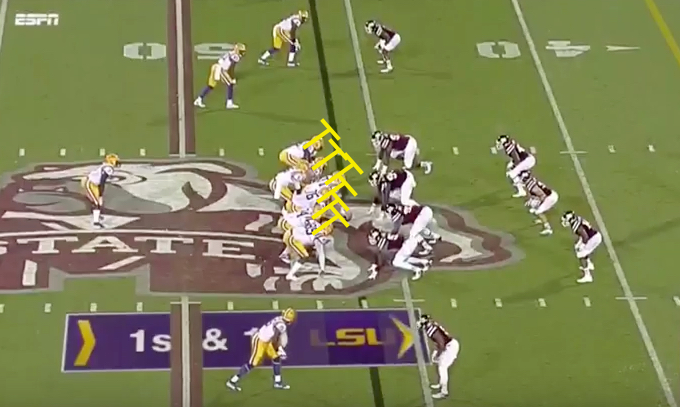
Slide Protection is a pass protection scheme where the offensive lineman each block a gap to the same side.

Slide Protection 1

Screen Grab Credit: ESPN

Slide protection is a little like zone blocking for a pass.  Each lineman blocks the same direction, left/right or strong/weak, whatever the call.  They step that way and block whomever is rushing that way.  It simplifies the blocking for the line.  Slide protection can be the entire line or just half of it.  In both schemes it is very important that the lineman maintain good spacing and do not get too far apart.

Slide 2

Screen Grab Credit: ESPN

From an individual technique perspective, at the same time the lineman is stepping toward the gap he is to block, he will “punch” with his backside hand at any defender over him or shading his backside shoulder.  This will help slow down the rush a little to allow the backside defensive lineman to get there.  On the second diagram above, you can see the center using this technique.


Gridiron Glossary is a resource for football terms that are often used by commentators, coaches and players but rarely defined.  If there is a term you have questions about or a definition you don’t agree with, let me know at billy@thirddowndraw.com.

Posted in Concepts, Glossary | Tagged | Comments Off on Gridiron Glossary: Slide Protection

Run Fits with South Carolina’s Jon Hoke

Everybody has to worry about run fits. New South Carolina defensive coordinator Jon Hoke mentions them each week when he is interviewed. After practice on Friday he was asked to explain some more for the less technically savvy fan. Here’s what he had to say:

Well you know there is an A gap, a B gap, a C gap, and a D gap when you break it down at the end of the day. And when you are an eight man front everyone is responsible for a gap, so you got to fight to control your gap.

To elaborate on his explanation the first thing the defense has to make sure it can defend against is the run. The offense has to run the ball through the space between its lineman called gaps. Before the play, each defender has responsibility for a gap. (Some defenses use two gap responsibility, but that’s another topic and not what Hoke is doing this year.)

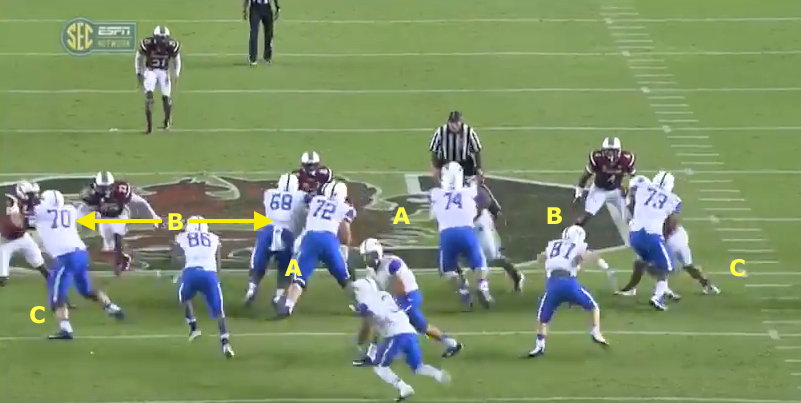
The offensive formation will alter some of the gap responsibilities, but the fundamental principle remains the same: every gap has a defender who will theoretically stop the ball carrier from running there. Having a defender for every gap is the first half of a run fit. Here are the gap responsibilities of South Carolina for one play against Kentucky.
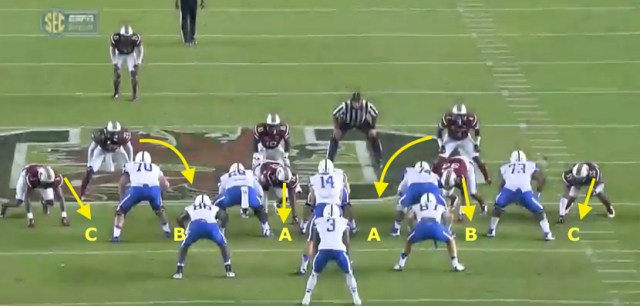
Run Fit v Kentucky

Screen Grab Credit: SEC Network

All of the gaps are covered, but that’s only half of a run fit. The second part is controlling the gap. To control the gap the defenders have to control the inside half of the gap. They cannot allow themselves to be pushed out, or worse, back.

The gaps are nice and clean before the snap, but as the play develops they can get bigger. Fitting the inside half of the gap is where the defender needs to be to stop a run from coming through there. Here is the same play a few seconds later.

A gap gone

Screen Grab Credit: SEC Network

This play was very successful for Kentucky. On the play side (the left side of the diagram) look at the A gap. It’s gone, so no running back will be running through there, but the defense doesn’t have gap integrity there. The defensive tackle is being pushed back and away and is directly across from the center.

Because the A gap defender is being pushed out of the play, look at the size of the play side B gap. The linebacker is going to have to make a good play to handle that big hole and a lead blocker (#86). He doesn’t, and the play goes for about 20 yards.

Run fits are often confused as just being gap responsibility, but they are more than that. Look at the South Carolina defensive tackle who had responsibility for the A gap. An uninformed observer may think, “he’s doing his job; the A gap is closed.” However, because the A gap wasn’t closed properly, the B gap is now huge.

When coaches are talking about run fits, they are talking about being sound in lining up; they are talking about being sound in technique and attacking the proper part of the gap and the offensive lineman, and they are talking about not being blocked. It’s all of those things.

Thinking about it another way: t he offense is going to try to move defenders around, push a lineman this way, block another one that way, and if they are successful, holes will develop in the defense. The philosophy and technique of not allowing that to happen through gap control is what the coach means by run fits.

Posted in Concepts, Schemes | Tagged , , , , | Comments Off on Run Fits with South Carolina’s Jon Hoke

Gridiron Glossary: Nickel

The nickel is a defensive formation feature five defensive backs.

Nickel

Standard defensive formations have four defensive backs: two safeties and two cornerbacks.  A nickel is a variation where a fifth defensive back is inserted into the game, usually in place of a linebacker.  Originally the formation was conceived and employed to combat passing teams and formations featuring many receivers.  Today it is often used against Spread offenses.

Some teams use a nickel as their base set running a 3-3-5 or 4-2-5 defense. The fifth defensive back in those teams is usually a player dedicated to that position.  Other teams use an additional safety or an additional cornerback as their fifth defensive back.


Gridiron Glossary is a resource for football terms that are often used by commentators, coaches and players but rarely defined.  If there is a term you have questions about or a definition you don’t agree with, let me know at billy@thirddowndraw.com.

Posted in Concepts, Glossary | 1 Comment

How Notre Dame Can Stop Georgia Tech’s Option

After the season opening blowout of Texas and survival against Virginia, Notre Dame’s pre-season expectations seem less like hype and more like reality.  They will take that hype to Atlanta to play Georgia Tech.  The Yellow Jackets are off to their own hot start (against less than compelling competition) but remain a dark horse candidate to make the playoff.

2000px-NotreDameFightingIrish.svgNotre Dame, the perpetual blue blood, forever on the cusp of a return to glory, is trying to make their way into the playoff by forging their own path as an independent.  On the other side is Georgia Tech, the often overlooked ACC power who is written off for running a gimmick offense, trying to forge its path on the back of an offense everyone hates to face.

Like every Georgia Tech opponent, the Fighting Irish will be tasked with shutting down Paul Johnson’s Triple Option offense.  Notre Dame is better suited to stop the offense than many of the Yellow Jackets’ opponents because the Irish see the triple option every year from Navy.  The Midshipmen run a very, very similar version of the offense GT does because Navy head coach Ken Niumatalolo is part of the Paul Johnson coaching tree.

Even so Notre Dame defensive coordinator Brian Van Gorder has a difficult task stopping the Yellow Jackets.  The offense is fundamentally sound, creatively varied and run by experienced players who know what they are doing.  Van Gorder also doesn’t have the best track record against the offense surrendering 39 points to Navy last season.

Stopping the Option

Van Gorder was asked about the option before playing Navy last season and said candidly, “there’s nobody out there that has the answer.”  That sure is honest, if not reassuring, for the Irish faithful.  He elaborated that a “good, solid preparation and a good philosophical approach is required.”  He’s right. Continue reading

Posted in Concepts, News, Schemes | Tagged , , , , , | Comments Off on How Notre Dame Can Stop Georgia Tech’s Option

Gridiron Glossary: Scrape Exchange

Scrape Exchange is a defensive technique where a linebacker and defensive end exchange their responsibilities.

Usually a defensive end lined up wider than a linebacker will have contain responsibility, meaning it is his job to make sure the ball carrier doesn’t run to the outside.  The inside linebacker has fill responsibility, meaning it is his job to fill the area between the contain man and the rest of the players.  Here is standard:

Standard responsibility

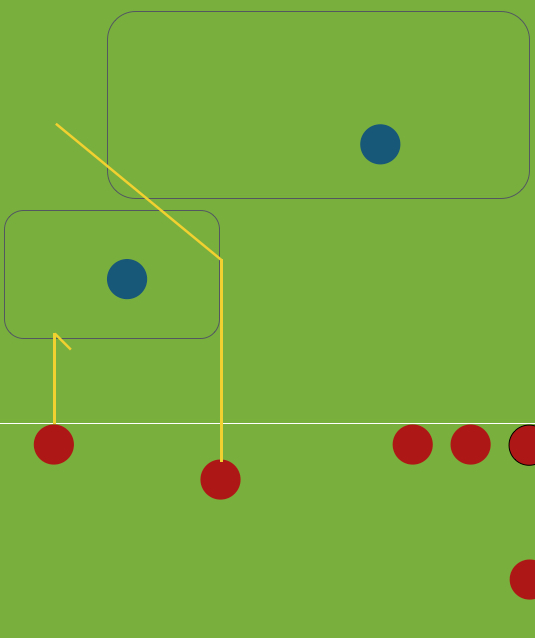
In a scrape exchange, the two players exchange roles.  The defensive end fills the gap, and the linebacker scrapes to the outside to contain.  The scrape is the technique of moving down the line of scrimmage and closing the gap with the running back.  Here is the scrape exchange:

exchange


Gridiron Glossary is a resource for football terms that are often used by commentators, coaches and players but rarely defined.  If there is a term you have questions about or a definition you don’t agree with, let me know at billy@thirddowndraw.com.

Posted in Concepts, Glossary | Tagged | Comments Off on Gridiron Glossary: Scrape Exchange

Gridiron Glossary: Swinging Gate

The Swinging Gate is a football formation, usually used on PATs, where the linemen line up away from the center to the side as shown.

Swinging Gate

There are variations on the formation, but the idea is the same: create advantageous match ups to gain two yards.  The most common approach is for the offense to get into the formation and execute a play based on a mismatch.  If no mismatch is present, most teams reset to a traditional field goal set and kick the PAT.

Common plays are to use the two players behind the center to run the ball either with one blocking or as a speed option.  The wideout is sometimes thrown to.  A direct snap from the center to the running back behind the line is sometimes employed.  The center is often an eligible receiver as well by virtue of being the last man on the line.  Many variations exist.


Gridiron Glossary is a resource for football terms that are often used by commentators, coaches and players but rarely defined.  If there is a term you have questions about or a definition you don’t agree with, let me know at billy@thirddowndraw.com.

Posted in Concepts, Glossary | Tagged , , , | Comments Off on Gridiron Glossary: Swinging Gate

Variations on the Smash in E Lansing

Michigan State defeated Oregon Saturday night in a game that was supposed to be a clash of styles.  From the West Coast came Oregon with their fancy uniforms and fancy, high octane offense to match.  Contrasted against the new power were the Michigan State Spartans of the Big Ten, a defense first team running a traditional offense.

The result of the game wasn’t a vindication or indictment of either team or philosophy: they’re both quite good.  In fact, when push comes to shove, they attack some problems quite similarly.  Look at two key 4th down plays in the second half.  On each play, one by Oregon and one by Michigan State, both teams passed for first downs using the same concept.

A smash route is a combination of two routes to put a cornerback playing zone coverage in conflict.  One receiver, usually the outside receiver runs a pattern to the flat in front of the corner.  Then another receiver, usually from the slot, runs a corner route behind corner.

Smash Diagram

The cornerback is forced to choose.  Both receivers are in his zone, and he can’t cover them.  To make matters more difficult the receiver in front of him is hard to ignore since he is in his line of sight.  He may be unaware of a receiver behind him until the ball is thrown.  If the defense is playing cover two, the safety is likely too far away to help with the deeper route.  The quarterback makes his choice based on what the corner does and throws the ball. Continue reading

Posted in Concepts, News | Tagged , , | 1 Comment

Gridiron Glossary: Snap Infraction

A snap infraction is a dead ball penalty that occurs when the center simulates a snap or moves the ball after touching other than when snapping it.

4387

Once the center gets in his stance and holds the ball, he cannot then make any movement that is like a snap, other than the snap.  He cannot pretend to snap or move in such a way to try to draw the defense off sides.  If he moves before the snap, it is a false start, like any other player.  If he makes some movement with the ball, other than a snap, it is a snap infraction.

The center can’t move the ball forward either, such as a slight forward movement before a regular snap.  Sometimes long snappers do this, and it is a penalty.

The center can let go of the ball and get reset, but he has to do it in such a way that it in no way simulates a snap.  Usually this is done by lifting the hand vertically off the ball.

Note that the rule doesn’t proscribe the ball must be snapped between the center’s legs.  That is done for other reasons not because the rule requires it.


Gridiron Glossary is a resource for football terms that are often used by commentators, coaches and players but rarely defined.  If there is a term you have questions about or a definition you don’t agree with, let me know at billy@thirddowndraw.com.

Posted in Glossary | Tagged , | Comments Off on Gridiron Glossary: Snap Infraction