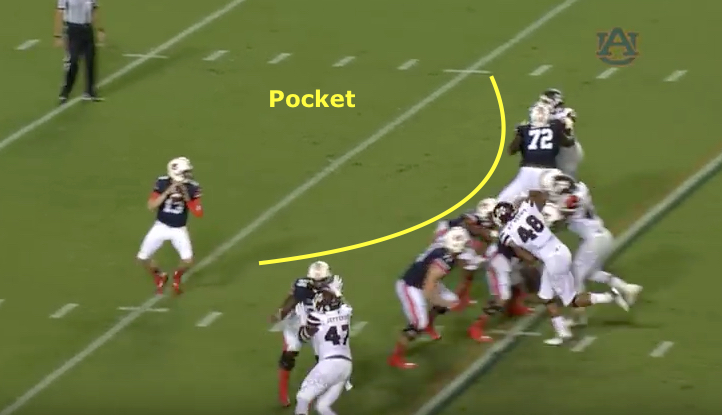
The area in the backfield from which the quarterback throws the ball after dropping back.
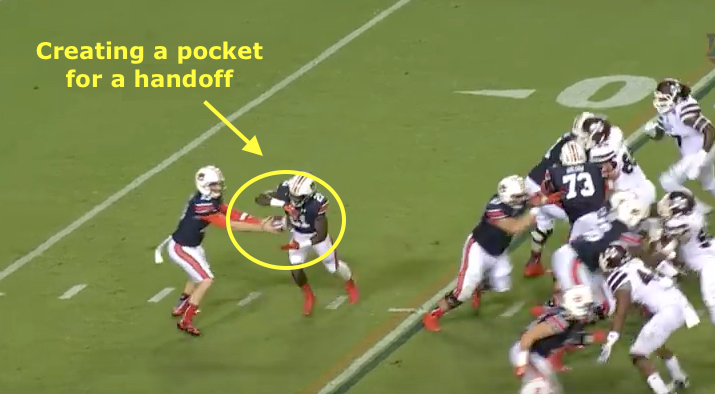
The space for accepting a handoff created by a ball carrier’s hands.
Putting it in his pocket, a phrase describing a quaterback taking a sack on a pass play by protecting the ball instead of continuing to try to throw
Here is a picture of the pocket from (1)
The pocket is created by the blocking scheme. Ideally it should be a protected area where no defenders are. When that happens, like in the photo above, it is called a clean pocket.
The pocket a running back creates is the safest way to accept a handoff and is generally accepted as the proper way to accept the ball. Note that the running back in the picture below is not reaching for the ball but allowing the quarterback to place it in the pocket.
The third usage of pocket is a metaphor for a quarterback’s decision. The quarterback is said to put the ball in his pocket if he stops trying to throw the ball either because of coverage or the risk of a sack or fumble.
Gridiron Glossary is a resource for football terms that are often used by commentators, coaches and players but rarely defined. If there is a term you have questions about or a definition you don’t agree with, let me know at billy@thirddowndraw.com.
During the BCS Era, the nightmare scenario was always 3 undefeated teams remaining for two spots. In mid-October people would begin to speculate what was going to happen with all the undefeated teams. Some people rooted for an unsolvable problem to hasten the demise of the BCS, while others hoped for a clean resolution. Inevitably most all undefeateds would lose a game or two and things would sort themselves out.
The lesson every year was the same: things will look different in December than they do in October. This year will be no different. Right now Ohio State, Alabama, and Florida State, 75% of last year’s playoff, seem to be in strong position to make repeat appearances, but it’s October. A lot can, and will happen. What will happen? Of course we don’t know, but here are a few very possible scenarios that aren’t getting much attention.
Florida wins the SEC.
A number of strong candidates could emerge from the SEC West, but it is the winner of the East that could shake things up. Florida might not lose another game, but they really only need to beat Georgia to assure their place in the SEC championship game. They’re not going to lose to Vanderbilt or South Carolina, so a Cocktail Party win should put them in Atlanta. Once they get there one upset would send the Gators to the playoff.
Iowa represents the B1G.
The Hawkeyes are the Gators of the Big Ten. They play in the weaker of the two divisions and will probably win all of their games going forward. They’ll then face off against a team from the stronger side who will probably have a stronger resume. They will be underdogs in the championship game, but anyone can win one game. Why not the Hawkeyes?Continue reading →
The mesh is where the quarterback puts the ball into another players hands or against his stomach as part of a handoff or a fake handoff.
Screen Grab Credit: Auburn
The quarterback’s job is to put the ball on the running back’s stomach. The running back is not supposed to reach for the ball. He puts his forearms parallel to the ground with his arm closest to the quarterback high and his other arm down low. The quarterback should be able to slide the ball in (and out) of the pocket he creates. The running back should roll the top arm and the top of his body over the ball to take the handoff.
In the case of a fake, either because of an option or play action the running back still rolls over the ball, but the quarterback slides the ball back out.
Gridiron Glossary is a resource for football terms that are often used by commentators, coaches and players but rarely defined. If there is a term you have questions about or a definition you don’t agree with, let me know at billy@thirddowndraw.com.
The Pride.Iowa. Where did these guys come from? The Hawkeyes demolished Northwestern and are almost certainly going to be in the Big Ten championship game. It’s not even November and it’s tough to see a normal scenario where Iowa isn’t playing a Big Ten East team in December. In fact, expect the Hawkeyes to be undefeated at season’s end.
The Shame.Indiana. Football isn’t the forte of the Hoosiers. They are a basketball school. They raised expectations when they took Ohio State to the wire. Perhaps that’s why the Rutgers loss is so stinging. The Hoosiers can look good on offense, so it was odd to see them shutout in the 4th quarter when one score would have ended the game. Instead of a nice win, I blew a lead to might Rutgers.
The Pride. LSU. With all the talk about how strong the SEC West was going to be this season, is it any surprise that LSU, a perennial power, has risen to the top again? It took a little mad hatter magic to make it happen, but the Tigers rolled through Florida in another Saturday night classic. Everything is still on the table, and LSU could be adding more than a Heisman trophy to their case this winter.
The Shame.Ole Miss. There shouldn’t be any way SEC teams lose the American Athletic Conference teams. It shouldn’t happen. It doesn’t matter that Memphis is quite good, and Ole Miss had a bad day. The loss itself isn’t shameful. Flukes happen, but this wasn’t a fluke. The Tigers came back from 14-0 down to methodically destroy the Rebels. What a fall this must be off of the high of winning in Tuscaloosa a few weeks ago.Continue reading →
“College kickers” is a popular refrain on social media whenever a college kicker misses a field goal. The phrase is meant to be a reminder of how unpredictable kickers are in the college game, especially in comparison to the NFL. College kickers have earned their reputation; they do miss more, but they also have a disadvantage over their NFL brethren: hash marks.
In the NFL the hash marks are as wide as the goal posts, so every NFL field goal is essentially a straight shot. Not so in college, wider hashmarks mean kicks often have to start outside the goal posts and be guided back to center. Cincinnati was employing an interesting solution on Friday at BYU. Here is there kick formation.
Screen Grab: ESPN/Bearcats TV
Notice anything odd? The long snapper is not in the center of the formation. The snapper doesn’t hike the ball straight back. By angle snapping the kicker gains about two yards of leverage. Here is that picture again.
Screen Grab: ESPN/Bearcats TV
Note also the unbalanced line. Because the ball is being snapped at an angle, the protection has to move in order to avoid a block from the outside. An unbalanced line takes care of this, but it is also the limiting factor for how wide an angle can be used to line the kicker up. The kick still must be protected from rushers off the edge.
This is an innovative approach, and so long as it doesn’t disrupt the kicker himself, expect to see more of this type of set up.
Les Miles, the resident Mad Hatter in Baton Rouge, reached into his bag of tricks for a fake field goal to beat Florida on Saturday in Death Valley. Miles has been known for late game risks and fakes, including field goals. How’d he pull this one off? Here’s the video if you haven’t seen it, from Saturday Down South.
Florida is in an aggressive field goal block defense. The entire Gator defense is along the line of scrimmage except for one safety. Then at the snap, every defender except for the safety and one player on the left side of the Florida formation rushes the kick to block it. Why did that player one player on the left side (from Florida’s view) not aggressively rush, probably because Florida remembered this play and this play. History and film review taught them that LSU has a fake field goal play running to the right.
The ball was snapped to the holder who started to set the ball down like normal. As the ball was being snapped the kicker moved laterally to get as far outside as possible, then the holder threw him the ball. The Florida defense on that side of the ball took themselves out of the play during their normal kick block rush.
The two LSU players furthest on the left side immediately released to go block any defenders who would be flowing to the ball. The pass or lateral was behind the line of scrimmage. It is important it happen that way. The pass being behind the LOS allows the blockers to block downfield without pass interference being called.
Speaking of the rules, isn’t a player down when his knee is on the ground? Yes, usually that is true. Rule 4-1-3-b is the one stating that if part of the player touches the ground, other than his foot or hand, he is down. However, in the case of a kick being held by a teammate, the player is not down. The exception then specifies that the ball may be kicked, passed or advanced.
This was a simple and effective fake. The scheme was simple in that the kicker need only get outside of the rushing defenders and catch the ball behind the line. Had Florida been in a more conservative defensive alignment, it probably would still have worked because of the two blockers stopping flow.
The timing, of course, was of critical importance. It was 4th quarter of a tie game. You’re supposed to kick the ball to take the lead then. It was 4th down and 13; you don’t fake it when you need 13 yards. It was a 33 yard field goal. That distance is long enough that blocking it is possible and worthwhile to attempt. It wasn’t too short (almost certainly to be made) or too long (likely to be missed or faked). It was the right distance to try to block. The fake call was so effective because it wasn’t the time to fake, and everyone knew it, even Florida.
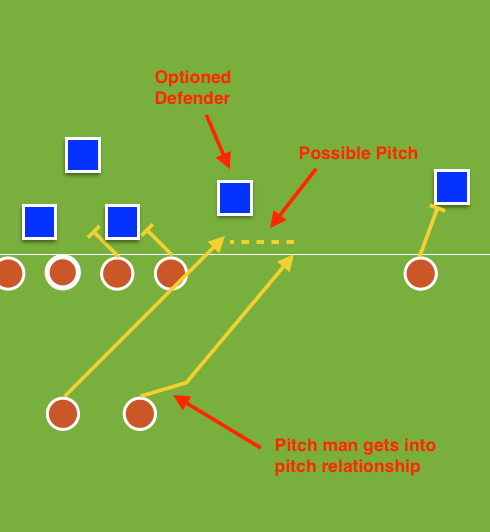
The speed option is an option play where the quarterback immediately attacks the optioned defender without utilizing a potential handoff to a running back first.
The speed option is fast compared to the triple option. The speed is created by the quarterback who immediately attacks the optioned defender. He doesn’t read a defensive tackle or have the option to hand to a fullback. There are only two options, not three.
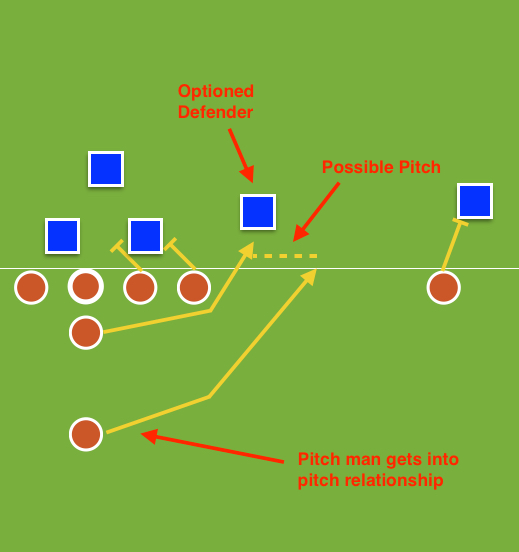
As the quarterback starts to attack the defense, the pitch man gets a predetermined distance away from the quarterback, called pitch relationship. It is far enough away so that the defender being optioned cannot defend both men, but it is close enough so that the pitch can be made quickly and easily. It is the running back’s job to stay the correct distance away since the quarterback’s attention is on the defender.
The quarterback then makes the defender choose. If the defender chooses the quarterback, he pitches; if the defender chooses the pitch man, he keeps.
Shotgun is a useful formation to run the speed option, but it can be run from any formation. Here is the play from another formation.
Gridiron Glossary is a resource for football terms that are often used by commentators, coaches and players but rarely defined. If there is a term you have questions about or a definition you don’t agree with, let me know at billy@thirddowndraw.com.
Jim McElwain is a Wizard. In the waning years of the Will Muschamp era Florida was known as much for its dysfunctional offense as it was for its dominating defense. The offense was so bad that it was assumed it would take multiple years to get it back on track. McElwain had the Gator offense humming in a few games. The emergence of quarterback Will Grier put Florida in a position to compete for the SEC East.
Last week Grier was suspended and it seemed the Florida offense would return to its recent doldrums. Treon Harris, a quarterback who had plenty of experience during the Muschamp era, stepped into the starting role. Having seen Harris play there was little hope that Florida would be scoring much on LSU in Death Valley. Florida put up four touchdowns and looks more than competent again.
This Florida Gators team is going to win the SEC East, and they will still be in the conversation for the playoff in December. They are going to beat Georgia in the Cocktail party, possibly badly and then cruise until they play Florida State. There’s no reason to think they cannot win that game; then anything can happen in Atlanta. Jim McElwain isn’t just good; he’s a wizard.
Ohio State is back. The Buckeyes have been the incumbent number one team all season based on the way they finished last year. If they were being judged solely on their accomplishments from this season, they would be a Top 10 team, but not a Top 5 team. More than anything Ohio State has looked like a very talented team playing a bunch of teams who aren’t very talented. They’ve won, but it hasn’t always been pretty, and it’s rarely been impressive.
Finally, this week Ohio State started to look like the team that steamrolled their last three games last year. 38 points against Penn State is what we’ve been expecting from OSU all season. We finally got it. The Buckeyes are rounding into form and just in time, too. With upcoming games against two very good teams from Michigan, they couldn’t afford to be less than their best any longer.
Last year Ohio State peaked at the perfect time. They played their best football for three games at the end of the year. What about this year’s team? Have they put it all together earlier? Will they be able to maintain this high level of play for the entire season, or are they peaking for three or four games? Time will tell.
Alabama’s is not winning the national title. Nick Saban has put together another incredibly talented, incredibly deep Alabama team. In the Top 10 with one loss, the Crimson Tide control their destiny and should end up in the playoff. They are a very good team, but they are not like the great Alabama teams we remember. They don’t have the spark on offense, and the defense doesn’t dominate like those teams from 3-4 years ago. They are still very good, but don’t make the mistake of thinking they are truly great, even after big wins.Continue reading →
An offensive play in which the ball is run in one direction before being handed or pitched to another player running in the opposite direction.
A reverse is designed to use the defense’s pursuit against itself. The play begins by running in one direction and the defense runs to that side of the field to make the tackle. Then another player, who is coming in the opposite direction, is given the ball with a running start.
The proper way to defend the reverse is to have backside pursuit through the backfield. The defenders on the back side of the play, particularly the defensive ends must chase the play through the backfield. If they pursue down field, the reverse can be effective against them.
Usually a wide receiver is the player who is handed the ball on a reverse, but every time a receiver is handed the ball is not a reverse. An end around play where the receiver comes through the backfield to take a hand off is not a reverse. The ball must be moving in one direction and then have another player reverse that direction for it to be a reverse.
Gridiron Glossary is a resource for football terms that are often used by commentators, coaches and players but rarely defined. If there is a term you have questions about or a definition you don’t agree with, let me know at billy@thirddowndraw.com.
A pass pattern, usually run in combination with a post pattern, in which an inside receiver or running back moves in a circular pattern toward the sideline and then continues vertically up the sideline.
Here’s the play from the 2015 Notre Dame – Clemson game.
Gridiron Glossary is a resource for football terms that are often used by commentators, coaches and players but rarely defined. If there is a term you have questions about or a definition you don’t agree with, let me know at billy@thirddowndraw.com.







 Third Down Draw