Bravo Big Ten

Conference commissioners and coaches have been talking about what teams’ schedules should look like for years.  At its media days event the B1G took the lead in scheduling.  Beginning with the 2016 season, all Big Ten members will be required to play 9 conference games and an out of conference game against a team from another Power 5 conference (or BYU or Notre Dame).  No more FCS schools can be scheduled either.  The B1G moved unilaterally, and it remains to be seen if others will follow suit.

b1g

Other conferences have always had their talking points about their strength of schedule.  The SEC has called itself the deepest conference and promoted its regular season as more difficult than other conferences’.  The Big 12 sought to sell its round robin format as the only schedule to produce “one true champion”.  Now the B1G has positioned itself at the top of the strength of schedule debate.

The Playoff

Having teams in the playoff is now of chief importance to all conferences.  As we saw last year there is going to be plenty of teams vying for the last spots in the Top Four.  Often there is little to distinguish teams competing for the last spots in the playoff, and without head to head results perception is as important as results.  The Big Ten’s scheduling gives their candidates the benefit of the doubt in the strength of schedule debate. Continue reading
Posted in News | Tagged , , , , , , , | Comments Off on Bravo Big Ten

Insulting the Offense that Beat You

Has your team ever lost to an underdog running a new offense?  Have you seen a team you don’t respect beat a more traditional team by running an unorthodox attack?  Did a trick play sucker your defense?  When one of these things happened, did you dismiss the offense or the play as a gimmick?  You probably have; I have.

Calling an offense or a play a gimmick is an enduring way to insult the team that ran the offense.  The pejorative term carries the implication the defenders weren’t so much beaten as they were tricked.  Coupled with that bit of cognitive dissonance is the further proposition that if the two teams played again, the trick wouldn’t work.  It was only fortuitous circumstances that allowed the play to work, and the score end up as it did.  The offense wasn’t really better; it was just a gimmick.

A gimmick play or, in less loaded language, a gadget play takes advantage of a defense’s lack of sound fundamentals.  The defense is too quick to run to the ball, or they don’t maintain proper pursuit angles.  They fail to ensure a player has the ball before chasing after him, or make any of a thousand other mistakes leaving themselves vulnerable.  Then the vulnerability is exploited. Continue reading

Posted in Concepts | Tagged , , , , , , , , | 2 Comments

Asymmetric Warfare with Bret Bielema

George Washington had to be a four touchdown underdog to the British.  The opening line should have been higher, if not for the French money coming in on the Americans’ side.  There was simply no way the colonials could go toe to toe with the redcoats and win, and they didn’t.  The revolution wasn’t won by beating the British at their own game; it was won by playing a different game.  It was won through asymmetric warfare.

When two nations or armies or football programs whose relative power varies greatly, the weaker program must employ a different attack and style.  The best chance for the underdog to win is not to try to run the spread better than Gus Malzahn, create a more structured developmental system than Nick Saban’s process or call better plays than Steve Spurrier.  The route to success is to find your own advantages and make your own way.  It’s what Washington did in the revolution, and it’s what Bret Bielema is doing now at Arkansas.

During the golden era of the SEC (which may or may not be over) when the conference was winning the national championship every year, a template of the great SEC teams emerged.  Those teams used transcendent defensive line play, the origin of the SEC speed myth, as the catalyst for stifling defenses and paired them with a spread or pro style offense.  This structure was validated each national championship game, and most of the rest of the conference sought to emulate that model. Continue reading

Posted in Schemes | Tagged , , , , , | 1 Comment

Alabama – Louisville and “True Road Games”

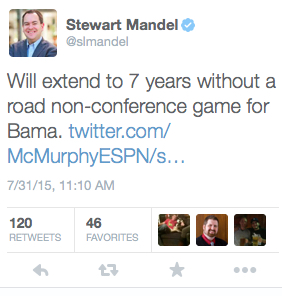
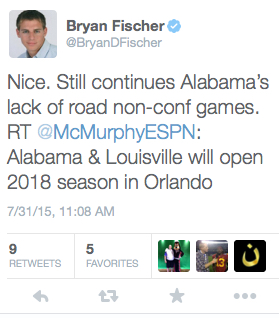
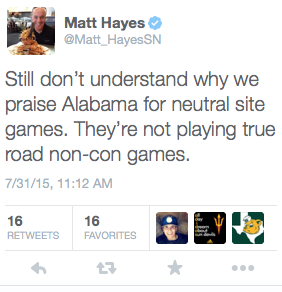
On Friday morning ESPN reported Alabama and Louisville have agreed to play a 2018 game in Orlando to open the season. Immediately many on twitter derided the fact that the game was not a true road game.

Fischerj Hayesj Mandelj

Some expanded their critique to assail Alabama’s road scheduling and the SEC’s in general. Of course, they are right that Alabama doesn’t play many road games against teams from Power Five conferences. Usually they schedule a neutral site game at the beginning of the year and play the rest of their out of conference games at home, against lesser opponents.

The match up with Louisville is not a true road game. It’s going to be in Orlando, not Louisville. For many of us, that’s fine. Louisville and Alabama have good football programs; the game will probably be entertaining. The build up will certainly be worth watching, and the game itself will command a prime television slot on a major network. Continue reading

Posted in News | Tagged , , , , , , , , , , , , , | Comments Off on Alabama – Louisville and “True Road Games”

The Hurry Up Advantage

All of football is action and reaction.  The offense substitutes; the defense substitutes.  An offensive formation causes a defensive reaction and formation.  Motion, initiated by the offense, is reacted to by the defense.  And when the ball is snapped, the offense begins a play to which the defense reacts and all of the players on the field act and react to one another.

Invariably the offense is granted two advantages to begin: the choice of the play to be run (and knowledge of it) and the ability to move first.  The defense has the advantage of “having the chalk” second, getting to see the formation and set its defense based on the offense.  It also has the advantage of the status quo.  It is incumbent upon the offense to move the ball forward.  If that doesn’t happen, if the play is a draw, where nobody wins and the ball stays where it is, that is to the defense’s advantage.

This narrative of action and reaction, with the offense executing the former and the defense the latter, is the basic structure of the game.  There is some brilliance in nearly upsetting the balance with a new system.

When hurry up offenses, Gus Malzahn’s version in particular, are working properly, they magnify the offense’s advantages while minimizing the defense’s.  Of course all offensive schemes attempt to do that, but there is something different in altering the fundamental relationship between action and reaction that can create an unusually large advantage. Continue reading

Posted in Concepts | Tagged , , , | Comments Off on The Hurry Up Advantage

Packaged Plays

The play action pass is such a beautiful play to watch because the moment when it looks like the running play is doomed, suddenly it is revealed that this play is actually a pass, and the ball is sent down field.  Play action passes are effective because they are paired with a running play.  It is the appearance of the running play to which the defense reacts, which creates the deception to make the pass successful.

This simple pair of complementary plays is part of a family of plays where each one is a variation on an initial, base play.  Here the run play is the base play; the play action is the variation.  All teams and all coaches employ some families of plays or variations on their base plays.  Families of plays are often much bigger than two plays.  Take, for example, a basic running play, whether it be a power or dive or iso.  The action in the backfield is straight forward.  The ball carrier heads directly for the hole and is given the ball on the way.  He may or may not have another running back blocking for him.  The offensive line can be zone blocking, veer blocking or utilizing another scheme. Continue reading

Posted in Concepts | Tagged , , , , | Comments Off on Packaged Plays

Talking Season with Steve Spurrier

Whenever people see a couple that doesn’t seem to go together, they never think the relationship is going to last. When a beautiful and successful girl is dating an out of shape, ugly guy, no one thinks they will be together for the long term. In fact, usually guys will continue to court the girl on the assumption that the demise of the relationship is imminent. In the case of South Carolina, the Gamecocks are the out of shape guy, and Steve Spurrier is the girl who is way out of their league.

This has been the feeling of many people from the start. First there was the lack of belief that Spurrier was going to go to South Carolina. Then there was the assumption that he would only be there for awhile before he would dump USC to move on to Alabama or Miami or where ever.

But 12 years later, he hasn’t left yet. That hasn’t changed the minds of those who still don’t see Spurrier as a Gamecock. Instead of assuming that Spurrier is going to leave for a prettier, better school to coach, now the assumption is that Spurrier will retire. He is still out of South Carolina’s league, and he will be leaving any year now. Any year now.

For more than a decade those calling for the imminent break up have been proven wrong offseason after offseason, and they had little to base their argument on other than “come on, look at him; look at her.” There was no real substance until December of last year. After finishing the regular season 6-6 and blowing double digit fourth quarter leads in three of the losses, Spurrier made his famous two or three years comment. Continue reading

Posted in News | Tagged , , , | 2 Comments