Gridiron Glossary: I Formation


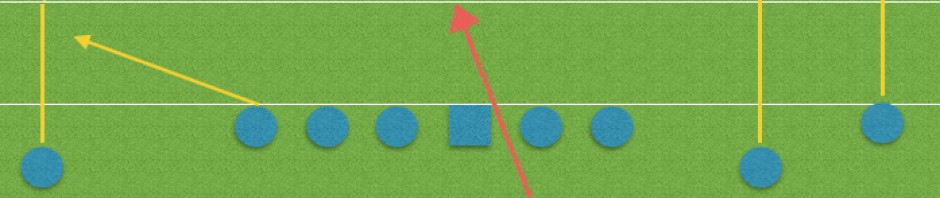
The I formation is an offensive formation in which the quarterback is under center, a full back is lined up directly behind the quarterback, and a tailback is lined up directly behind the full back.

I formationj

The I formation is one of the most common formations used at all levels of football.  The formation above is called I-left in most offensive schemes.  The left designates where the tight end is aligned.  Note a split end to the far side of the formation and a wide receiver to the near side.  While not necessary for an I formation, this arrangement is very common. Continue reading

Posted in Glossary | Comments Off on Gridiron Glossary: I Formation

Gridiron Glossary: 3 technique


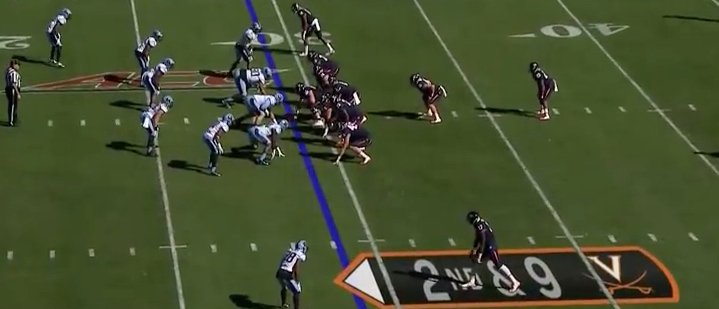
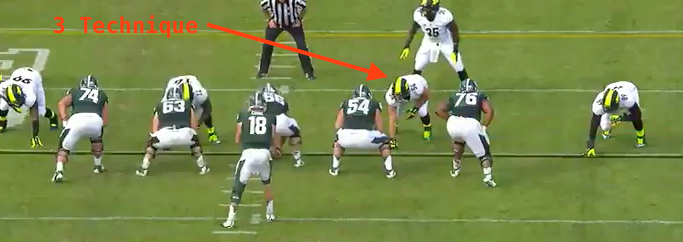
A defender is lined up in a three technique if he is one the line of scrimmage across from a guard’s outside shoulder.
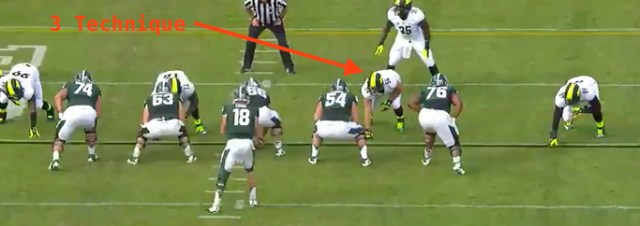
3 techniquej

Any defender can theoretically be in a 3 technique, but it is almost exclusively a defensive lineman, specifically a defensive tackle.  Some defenses have players who are designated 3 techniques in the same way an offense might designate a left guard.  Other defenses only have defensive tackles who may line up in a 3 technique.  The more sophisticated the football and the more specialize the players, i.e., the NFL, the more likely you are to have the 3 technique be a specific player as well as his alignment.

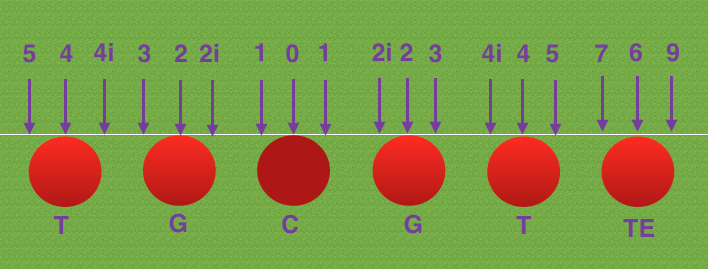
All positions along the defensive line can be understood through a numbering system.  The defenders are either directly across from an offensive lineman, called head up, or they are on a shoulder, called a shade.  Each position has a number, as follows:
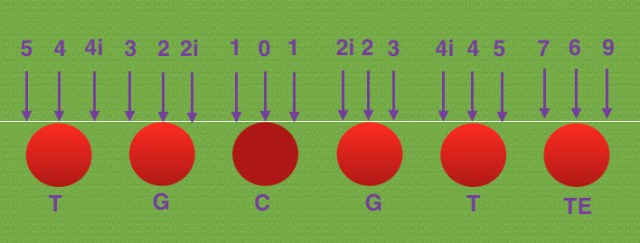
Line techniquesj

Even numbers indicate head up positions, and odd numbers indicate shade positions, most of the time.  The inside of the guard and inside of the tackle are both denoted with an ‘i’.  Why is that?  It just evolved that way.


Gridiron Glossary is a resource for football terms that are often used by commentators, coaches and players but rarely defined.  If there is a term you have questions about or a definition you don’t agree with, let me know at billy@thirddowndraw.com.

Posted in Glossary | 1 Comment

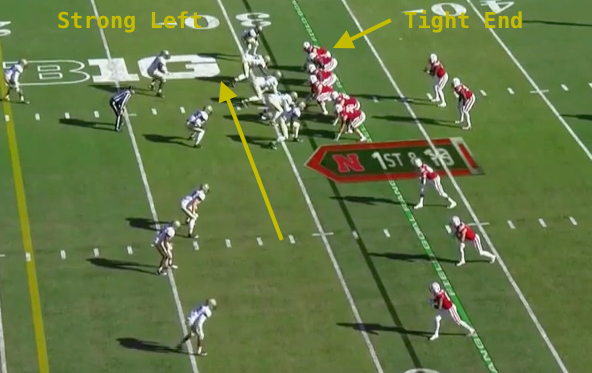
Gridiron Glossary: Strong Side

The strong side of an offensive formation is the side of the field, left or right, where the offense has more blockers available for a running play.

Many defenses or defensive calls rely on designating the strong side of the offense and its opposite, the weak side.  The defensive linemen may line up differently or slant to the strong side or the weak side, depending on the call.  The linebackers, particularly the Sam linebacker and Will linebacker, are dependent on a designation of the strong and weak sides to line up.  A player, usually the middle linebacker will often call out the strong side so the entire defense knows which side is strong.  There is always a strong side.

Strong side is determined by following a set of rules.  The first rule is that if there is a tight end to one side and not the other, the tight end side is the strong side.

Strong Left (from defense's perspective)

Strong Left (from defense’s perspective)

Continue reading

Posted in Concepts, Glossary | Tagged , | Comments Off on Gridiron Glossary: Strong Side

How Alabama will Defend Wisconsin

Alabama will open the season against Wisconsin and their power run game in Arlington.  This week should be the time the Crimson Tide will begin to focus on the Badgers.  Of special importance to the Tide will be Wisconsin’s power running game.  Wisconsin runs a style of offense that Alabama doesn’t see very much except for once a year against Arkansas.

Last season the Hogs nearly beat Alabama in Fayetteville, losing 14-13.  Bret Bielema exported the Wisconsin running game to Arkansas, so expect Alabama to employ many of the same defensive techniques that were effective against Arkansas.

Alabama will be in their 3-4 defense most of the game.  They will be in a base formation often, but they will occasionally line the nose guard up in a one technique (across from the center’s shoulder) to the weak side and the defensive tackle in a three technique (across from the guard’s shoulder) to the strong side.  One or more outside linebackers will be flexed up on the line.

Alabama Basej

Strong Side Inside Linebacker Play

On most running downs, which will be often for Wisconsin, the Alabama inside linebacker on the strong side (usually the tight end side) will read the guard in front of him.  If the guard shows any sort of run block, the linebacker is going to immediately crash to the line of scrimmage.  If the guard is not pulling, the linebacker will engage him there.

Continue reading

Posted in Concepts | Tagged , , , , , , , , | Comments Off on How Alabama will Defend Wisconsin

Gridiron Glossary: Splits

A split is the horizontal distance between two offensive lineman when they are in the formation.

Splitsj

Splits vary by the offense, coach and situation.  When the offense lines up with wide splits they create large gaps.  Those gaps can be run through by a ball carrier or a defender.  When the offense lines up with tighter splits there is less room to run between them.  Tighter splits allow offensive lineman to more easily double team defenders and block defenders that aren’t lined up directly across from them.

Most defensive fronts line up on the offensive lineman.  For instance a particular defensive tackle who is supposed to line up on a guard’s outside shoulder will do that whether the guard is two feet or four feet away from the center.  If the splits become too wide, the defense may adjust its alignment to take advantage of the holes.


Gridiron Glossary is a resource for football terms that are often used by commentators, coaches and players but rarely defined.  If there is a term you have questions about or a definition you don’t agree with, let me know at billy@thirddowndraw.com.

Posted in Glossary | Comments Off on Gridiron Glossary: Splits

The Narrative: The Fruit of Talking Season

After the last whistle of the last game until the kickoff of the first game, we are mired in talking season.  We talk and talk and talk.  We rehash; we debate; we argue.  We do everything we do during the regular season, but we do it without the benefit of new games to discuss.

Continuing to debate and talk without any substantial, new input causes the debates to take on lives of their own.  As consensus, or plurality, begins to emerge, college football develops its narrative for the upcoming season.  This conventional wisdom, distilled down to a few concise talking points, will be the yard stick through which disappointment or surprise will be measured during the season.

How to Craft A Narrative

To craft a narrative you need a hypothesis or a thought or an idea to float.  The idea will either explain why something happened last season or in seasons past or it will predict something in the future.  For example think back to 2007 after Florida beat Ohio State.  The hypothesis began: perhaps the Gators won because their defensive linemen were faster than the Buckeyes. Continue reading

Posted in Uncategorized | Tagged , , , , , | 1 Comment

NCAA Dodges Bullet, Will Still Face Firing Squad

On Monday the National Labor Relations Board declined to exercise jurisdiction over the case to unionize Northwestern football players.  Essentially the NLRB declined to make a ruling in the case, which is a loss for the plaintiffs trying to unionize the Northwestern football team.  It’s a big win for the NCAA and one that staves off its destruction, for now.

National_Labor_Relations_Board_logo_-_colorThe Northwestern NLRB case highlights an on-going issue that will have to be resolved at some point.  The issue, the original sin of college athletics, is that amateur students are forced to adhere to rules ensuring they do not earn money while at the same time they generate millions of dollars for universities.

Some fans take issue with the use of the word forced when categorizing the relationship between student-athletes and universities.  Of course no one is physically coerced into becoming a division one athlete, and the trade of a scholarship for a spot on the team is mostly voluntary, but it is overly simplistic to ignore the fact that for some sports there are no alternatives.

If you want to play American football you have to play college football after high school.  There isn’t an alternative.  There is no way to go directly to the NFL like baseball players can go directly to professional baseball.  There are no overseas options like those that exist for basketball.  In fact, the NFL has a rule that a player must be three years removed from high school to be drafted.  That doesn’t leave much of a choice. Continue reading

Posted in News, Opinion | Comments Off on NCAA Dodges Bullet, Will Still Face Firing Squad

Ohio State’s System Quaterbacks

If you have two quarterbacks, you don’t have one. This cliche of conventional football wisdom sounds alternatively like Yogi Berra gibberish or an observation from a five year old. Usually this saying means that if one quarterback on your team hasn’t proven himself to be clearly the best option, neither of your options is very good. Usually two rotating or alternating quarterbacks isn’t as good an option as one solid quarterback. Usually a quarterback competition means trouble for the team. Ohio State has multiple quarterbacks, but their situation is anything but usual.

A plethora of talent at the quarterback position is rare. In fact, it is so rare that when we see it, the first thing we do is look for other explanations. It is not common to have a good quarterback after good quarterback. It is more likely that when we see quarterback production from successive quarterbacks an explanation other than talent is probable. One such explanation is an offensive system which elevates the statistical production of quarterbacks without actually improving the talent of the quarterback.

Statistics Reflect Talent?

Talent cannot be easily quantified. Instead we use statistics as a proxy for performance and from that we infer talent. When we have decided that a player is talented, based on statistical performance, we project future success. Sometimes that happens and sometimes it doesn’t. Continue reading

Posted in Concepts | Tagged , , , , , , , | Comments Off on Ohio State’s System Quaterbacks

South Carolina’s Zone Running Game

In Columbia, the Gamecocks are trying to bounce back from a disappointing 7-6 season. All eyes are on the quarterback derby and the improvement on the defensive line. If those two areas are strong, South Carolina’s season will be better than expected. Although those areas are in desperate need of playmakers and production, a more important part of USC’s success is going to come from the running game.

Steve Spurrier, a former quarterback, has always been known for his passing game. It was his aerial attack that revolutionized the SEC in the 1990s. When he came to South Carolina it was assumed that he would install the same offense there. For the first few years that was what he tried to do, and he had some marginal success. Then he upgraded his running game, and the Gamecocks started posting 11 win seasons.

Shawn Elliott, the offensive line coach and co-offensive coordinator, brought his zone running scheme from Appalachian State. The head ball coach wasted no time marrying his passing game with Elliott’s running game. When people talk about the evolution and adaptation of Steve Spurrier in Columbia, this is what they are talking about. This was the offense in which Marcus Lattimore so aptly showcased his talents, and this will be the sine quo non of a successful South Carolina offense in 2015. Continue reading

Posted in Concepts, Schemes | Tagged , , , , , | Comments Off on South Carolina’s Zone Running Game

Georgia Tech’s Option Play and Offense

Style defines.  The Fun and Gun defined Florida in the 90s.  Alabama is defined by their defense.  Ohio State is now known for Urban Meyer’s Spread offense.  In Atlanta Georgia Tech is the triple option.  Paul Johnson’s offense is called a triple option offense, which really isn’t accurate.  The triple option is a play that is run in the offense, not the offense itself.  In 2014 the Yellow Jackets averaged about 70 plays a game, about 10-15 triple options, so there were mostly non-option plays being run.

GT Orangebowlj

It is fair to call Georgia Tech an option team because they do run the triple option.  The triple option was once a very common base play in college, but teams have moved away from it in the last few decades.  The Yellow Jackets have developed their reputation because they are an anomaly and because they have been successful with a play that some scoff at as being from another era. Continue reading

Posted in Schemes | Tagged , , | 4 Comments