Paper Tigers

c01-sline-logo-30_001-4_32006 Ohio State.  2012 Notre Dame.  2014 Florida State.  What do those teams have in common?  They all went undefeated and were granted a chance to play for the national title.  In each instance the zero in the loss column was more important than any sort of evaluation of how good the team actually was.  In all three seasons, the undefeated (and untested) teams were obliterated in the post season.  Get ready to add another name to that list: 2015 Clemson.

Usually teams like this don’t make it to the national championship.  Most years they lose a game, either by an upset or by a better team.  But sometimes they make it through.  Sometimes the schedule isn’t hard enough and doesn’t provide enough tests and we get an undefeated team that is not elite.

Why aren’t more people talking about the lack of quality on Clemson’s schedule?  Why are the Tigers getting a pass?

There are some teams whose schedule is so weak they never get a shot at the Playoff.  Take a look at a team like Temple. The Owls lost to Notre Dame two weeks ago, but even if they had won that game, they weren’t going to the Playoff.  If Temple had gone undefeated, they might have earned a berth in one of the other bowls chosen by the Committee, but they were never going to sniff the Top Four.  And they shouldn’t.  Their schedule wasn’t hard enough to make them deserving.

In fact, on closer inspection Temple’s schedule is remarkably similar to Clemson’s.  Both teams played Notre Dame at home, and both play a Power Five school out of conference (Penn State for Temple, South Carolina for Clemson).  In conference both schools play one ranked team (Memphis and Florida State).  In a conference championship game each might draw a third ranked team, probably North Carolina and Houston.  Actually Temple seems to have the harder schedule, and they were never in consideration.  Clemson gets no questions.

Being undefeated is not enough to be deserving.  With only 12 games, we don’t know enough about the team.  In almost any other sport there are enough games to know that being undefeated actually means something.  Being undefeated in basketball puts you among the elite teams of all time.  Never do you see an undefeated team bow out of March Madness in a first round blow out.  We see it in college football.  Look at those teams listed above.  It happened to them, and Clemson is setting up to do it again.

2000px-Clemson_University_Tiger_Paw_logo.svgClemson has made their reputation on beating weak ACC teams.  They are the big fish in their small pond.  Their proponents point to the Notre Dame win as proof of their merit.  They did stop a Notre Dame two point conversion at home in a monsoon.  That game should be more reason to doubt them than to validate them.  Would it have been different if Notre Dame wasn’t playing their back up quarterback?  What about the weather aided turnovers; anyone remember those?  This is the type of game we will look back on and say “of course, we should have known.”

There are other red flags on Clemson’s resume too.  We’ll look back at the NC State game, where the Tigers gave up 41 points and remember that we should have known better.  41 points is the most NC State has scored in an ACC game this season.  It’s more points than they’ve scored against anyone other than South Alabama and Troy.  That’s not good company for the Tigers.

Florida State’s Dalvin Cook nearly rushed for 200 yards on Saturday.  Good defenses don’t give up 194 yards to anyone.  75 of those yards came on one play, so without that, the defense was good, right?  No, without that one run, Cook rushed 20 times for 119 yards, almost 6 yards an attempt.

But isn’t Clemson is led by their offense?  Yes, and you can use that if you want to believe Clemson is elite.  Their offense isn’t bad, but it isn’t part of a complete, number one team.  The Tiger offense is built to put up big points against bad teams and to create avalanches when things get out of control.  That’s the beauty of the offense, once it gets going, it piles up the points.  But it doesn’t always get going.  23 points against Florida State, 24 against Notre Dame and 20 against Louisville will be what we look back on.  When the Tigers get to the college football playoff don’t expect them to put up more than 20 points.  What has the offense accomplished against a good defense that would make us think otherwise?

Unfortunately for Clemson they won’t get to find out whether they are actually good or if they are just ACC good.  They’ll beat Syracuse, Charleston Southern Wake Forest and the last place team in the SEC East, South Carolina.  Then they’ll beat a UNC team whose resume is just as thin as their own.  They’ll be feeling good; Dabo will be dancing, and they’ll be in the playoff.  They’ll add their name to the list of pretenders who got to play for a national championship, their spot having been secured by their schedule rather than their merit.  And when they are blown out, we will look back at their entire season and say, “of course, we should have known, these are just paper tigers”

Posted in Opinion | Tagged , , , , | 42 Comments

What We Learned: Week 9

c01-sline-logo-30_001-4_3The ACC Doesn’t Have Anything for Clemson.  Saturday was the last chance for the Tigers to stub their toes.  Florida State is the only team in the ACC who has the talent to play 60 minutes with Clemson.  The Seminoles aren’t as good of a team, and it showed on Saturday.

We know Florida State is the best the ACC has to challenge the Tigers.  We also know that FSU isn’t all that good.  They are a fringe Top 25 team who has taken advantage of their schedule.  Given that, what do we know about the Tigers?  We don’t know that much.  Clemson will be undefeated and in the playoff, but they will be untested and unknown.

Don’t Get Tackled on the Last Play.  If Miami didn’t make it clear two weeks ago, Arkansas showed why you don’t want to get tackled on the last play.  On almost every play of a game turning the ball over is one of the worst things you can do.  Players are conditioned to avoid it, and great players who can’t get that part right don’t see the field.  All things being equal you never want to risk a turnover.

On the last play, all things aren’t equal.  That’s the time where the cost of a turnover is zero.  If you have to score on this play or you’ll lose the game, you have to risk everything to score.  If that means throwing the ball over your head and backward as you are going down, so be it.  If that means lateral after lateral after lateral, then do that.  Usually you’re going to throw the ball out of bounds or forward or lose the game anyway.  But sometimes the ball will bounce right to your running back, and you win the game.

The Cowboys Have Awoken.  It looks like someone told Oklahoma State they are supposed to be playing like a Top 5 team, and they listened.  Most of the season the Cowboys stayed undefeated with close and unremarkable wins.  They beat Texas thanks to a fluke punt.  Wins over Kansas State by two and West Virginia in overtime didn’t impress anyone.  You can read what you want into last week’s game against Texas Tech.  You could be impressed with the offense and their 70 points, or you could be unimpressed with the 53 points they gave up.  This week’s result was unequivocal.  Beating TCU by 20 points is impressive.  If OK State can avoid the upset at Iowa State, they come home for a pair season defining match ups against Baylor and Oklahoma.

31VN9nWog2L._SY355_Alabama is going to the Playoff.  The SEC West is deep and talented.  Each season it looks like all the teams are going to beat up on each other.  For most of the division that happens, except it has not happened for Alabama.  The Crimson Tide has only one blemish on their resume.  Five turnovers cost the Tide against Ole Miss, but that game looks more like a fluke in retrospect.

This weekend’s win over LSU is the hardest test Alabama will face until the playoff.  Mississippi State waits this weekend, but there’s no reason to think the Bulldogs are pulling an upset.  The next three games will then be against Charleston Southern, Auburn and Florida.  Any losses would be shocking.  Expect the Crimson Tide to be in the playoffs, and if they avoid five turnover games, expect them to win it.

Goodbye American.  A week after Temple lost its undefeated season to Notre Dame, Memphis lost theirs to Navy.  Only Houston remains undefeated in the American Athletic Conference now.

It was always a long shot for one of these teams to make the playoff, but it appears that is not going to happen at all now.  Houston can still run the table and get into a contract bowl, but they needed everything to break their way to get to the Top 4.  Included in those breaks would be beating an undefeated Memphis team in a high profile game.  The Cougars-Tigers game will still be worth watching, but the stakes have been lowered.

Who is Iowa?  Does anyone have a good read on exactly how good the Hawkeyes are?  They have an undefeated resume filled with incongruent results.  On the impressive side they have a win at Wisconsin, and they destroyed Northwestern.  Then they slipped by Illinois and Indiana, and their three point win over Pitt isn’t aging well.  This weekend against Minnesota they could win by 28 or lose.  Who knows who these guys are?  We’ll know for sure when they face Ohio State for the Big Ten title.

Posted in News, Opinion | Tagged , , , , , , , , , , | Comments Off on What We Learned: Week 9

Gridiron Glossary: Strong Safety

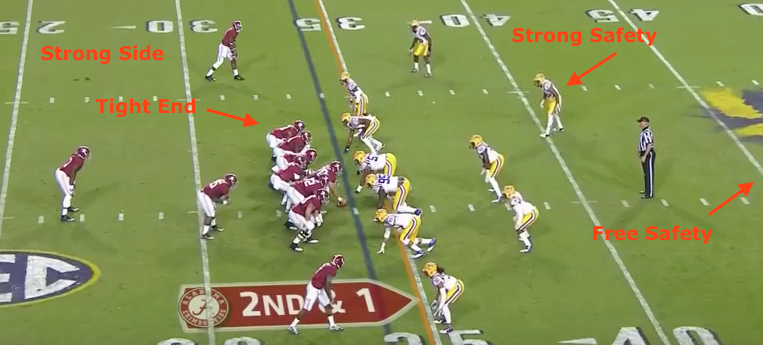
Strong Safety is the name given to one of the safeties (free safety is the other) to differentiate the two positions and divide responsibilities dependent on scheme.

Strong Safety

Most defenses have two safeties, the strong safety and the free safety.  Depending on the defensive call and the way the coordinator has set up the defense, each safety will have have a different responsibility.  The strong safety is usually the bigger of the two safeties and the better at stopping the run.

If one safety plays closer to the line of scrimmage to try to stop running plays, it is usually the strong safety.  The name comes both from the fact that he is to be strong against the run and because he often lines up to the strong side.  The strong side is the side of the offense where more blockers are available for a running play.

On coaching diagrams or defensive play cards the safety is often designated as SS or $.  When $ is used, S is usually just for the free safety.


Gridiron Glossary is a resource for football terms that are often used by commentators, coaches and players but rarely defined.  If there is a term you have questions about or a definition you don’t agree with, let me know at billy@thirddowndraw.com.

Posted in Concepts, Glossary | Tagged , , | Comments Off on Gridiron Glossary: Strong Safety

What We Learned: Week 8

logoHow did UNC lose to South Carolina?  After Thursday night’s win over Pitt, people wanted to know how this North Carolina team lost to that South Carolina team.  Short answer: South Carolina is better.  Their 3-5 record doesn’t look as nice as North Carolina 7-1 mark, but strength of schedule is everything.  Like I wrote last week, North Carolina, Pitt and Duke’s impressive records were built on the backs of weak competition.

How would North Carolina do against South Carolina’s schedule?  Probably 4-4, maybe 5-3.  UNC isn’t beating Georgia in Athens, LSU in Baton Rouge or Texas A&M in College Station.  They probably win the rest of the games, maybe they lose to Missouri or Kentucky, maybe not.  See what a difference schedule makes?

Duke Lost the ACC Coastal on an Officiating Gaffe.  By now you’ve seen and heard about the missed calls and botched replay at the end of the game Saturday night.  You may not have realized that call may cost Duke the Coastal.

Entering the weekend, North Carolina, Duke and Pitt were in a three way tie for the lead.  The round robin the three teams were going to play was going to determine the division.  Now there’s a wildcard in there.  Now if Duke doesn’t beat North Carolina and Pitt, they’ll be out.  Before splitting the round robin would have all but assured at least a share of the division.

2000px-UGA_logo.svgThis is Georgia.  Things is Athens follow this pattern more often than not.  Talented recruits pour into Georgia.  Off season hype builds, and is later crushed by a loss.  An unexpected loss or another loss or two occurs, and suddenly the sky is falling.  This is where we are right now in the Bulldog cycle.  Next, Georgia will win their remaining games, finish 9-3 and probably get their 10th win in a bowl game.  Everything will be fine again, and people will stop calling for Mark Richt’s head.

Kentucky’s Done.  The Wildcats upset South Carolina and Missouri early in the season.  They lost to Florida, but it was a close game.  Optimism was high when Auburn came to town.  For most of the game a win was within reach, but a crushing loss killed the momentum in Lexington.  The next two weeks Kentucky was blown out by Mississippi State and now Tennessee.  The optimism is gone, and everything is back to mediocre in the Blue Grass state.  Following next weekend’s loss, Kentucky should reel off three more wins to finish 7-5.  Hopes of a program changing season are gone as is the hope of a winning record in conference.

Houston looks good.  Vanderbilt has a good defense.  Perhaps is too strong of a word, but competent is accurate.  Houston put up 34 points on the Commodores.  That may not raise many eyebrows for those who haven’t paid much attention to Vanderbilt, but that is impressive.  Two weeks until the Houston Memphis game.

2000px-Clemson_University_Tiger_Paw_logo.svgClemson’s last test.  There was not Clemsoning in Raleigh.  If the Tigers were going to fall victim to historical mis-steps, last weekend was the time for it to happen.  Despite the game being slightly close in the fourth, the Tigers won, covered the spread and move on to this week’s big game.

Barring some sort of massive upset, it’s difficult to see how anyone left on the Tigers’ schedule can reasonably expect to stop a playoff run.  Florida State goes to Memorial Stadium on Saturday, and they stand as the last obstacle.  Win and the Tigers can start celebrating their playoff appearance.

Posted in News, Opinion | Tagged , , , , , , , , , , , | Comments Off on What We Learned: Week 8

ACC Bows to Howls of the Mob

So, the ACC has decided to suspend the officiating crew who blew the ending of the Miami Duke game.  After what I wrote earlier this week about officials and accountability, you might think I’m all for the suspensions.  You’d be wrong.

Why Suspend Them?

The ACC, to its credit, listed out the reasons the officials were suspended.  They didn’t properly rule that the ball carrier was down.  They missed a block in the back, and they didn’t notice a Miami player running on the field to celebrate while the play was on-going.

So, is this the scenario under which officials will be suspended by the ACC?  They will be suspended if they don’t call a player down properly on replay?  Is that all replays or just 4th quarter ones?  What about second quarter mistakes.  It is unlikely there wasn’t another missed knee down in the ACC over the weekend.

Will officials be suspended every time they miss a block in the back?  That will make kickoffs and punts fun.  All the officials can throw their flags out at once and then wait for the inevitable block.

Was it failing to notice a player running onto the field with his helmet off?  That was the least of the mistakes.  Had they flagged that, it would have been enforced as a dead ball penalty.  Since the game was over, it wouldn’t have been enforced.  Were the officials suspended because they didn’t call a foul that wouldn’t have been enforced?

No, we all know why the officials were suspended.  They were suspended because the ACC had to do something.  The calls were botched so badly that the winner and loser clearly changed.  The game was decided in the replay booth instead of on the field.  Sadly, those facts alone were not enough to suspend the crew.  The crew was suspended because the outcry was public.  Everyone who saw the game, except the Miami twitter account, knows what a mistake it was and many said so.

So, suspend them right?

The calls on the field and in the replay booth were wrong, but this suspension is wrong, too.  I’m sure the ACC has some sort of rule allowing them to suspend officials if the best interests of the game require it or if they want to.  There’s some loophole that allows them to do this.  They can do this, but they should not do this.

There has to be clear accountability of officials, and conferences (who employ officials) need to enforce that.  But, the enforcement has to be grounded in objective rules.  It can’t be decided based on how loud the public outcry is.  When the conferences make public relations issues their standard for administering “justice” they will make arbitrary decisions, like this one.

What if this game was on ESPN3 or wasn’t on TV?  Would the officials have been suspended then?  I doubt it.  If we weren’t all watching the travesty take place live on Saturday night, there wouldn’t have been the outcry.  There wouldn’t have been the need to do something.  There wouldn’t have been any suspensions.

This Isn’t Good Enough

The ACC would have you believe they acted with decisiveness.  They have sent a clear message that they are doing the right thing.  They aren’t.  They’re trying to slap together some semblance of accountability and justice that has been missing from their MO for decades.

They’re not alone.  All of the conferences review (or don’t review) their officials in private.  They scold or praise, ignore or berate their officials behind closed doors.  Maybe they are excellent at it, and maybe they are responsive to on field performance.  Perhaps the best officials rise to the top and are rewarded each year, but they probably are not.  We don’t know.

Ad hoc “justice” is not way to run a conference or to treat your officials.  Criticism of officials is par for the course and a part of the game.  That shouldn’t change.  Offering up the officials to the crowd isn’t justice.  It’s shifting the focus away from a lack of a comprehensive and transparent evaluation process.

Posted in News, Opinion | Tagged , , , | Comments Off on ACC Bows to Howls of the Mob

Officiating Needs Transparency

Everyone saw the bizarre ending to the Miami Duke game on Saturday night.  Depending on your point of view, it was a wonderful example of how great college football can be or it was a travesty for which there is no real remedy.

If you missed it, Miami completed a series of laterals on a kickoff return to score the game winning touchdown with no time on the clock.  A flag was thrown for an illegal block in the back, and the play was reviewed.  Review showed a Miami ball carrier down, but after the lengthy review, the officials announced they were picking up the flag and awarding Miami a touchdown and the game.

The outcry was immediate and one sided, especially on social media.  Everyone with access to a television, other than the Hurricane faithful, disagreed with the conclusion of the replay officials.  Even more galling was the assertion by the officiating crew that the block in the back was not a block in the back.  Only certain items can be reviewed on replay and whether a block in the back was proper is not one of them.

Plainly put, the officials blew it.  They didn’t call the play correctly and changed the outcome of the game.  This wasn’t the only game where that happened.  In every game, every weekend, these type of missed calls or wrong calls happen.  Rarely do they so clearly and definitively impact a game, like they did in Durham, but they do affect games.  And after the game, what happens?  As far as the public knows, nothing.

Coaches are prohibited by most conferences from commenting on the officials or the calls.  So, when a big call or no call changes a game, naturally the media will ask the coach about it.  He can’t answer.  He’s not allowed to.  Through a secret process the school can petition their conference.  They can complain.  Apparently discussions and reviews will take place.  None of it will be public.  Even if there is nothing improper going on behind the scenes, the fact that all proceedings are hidden gives rise to the appearance of impropriety and, if you are so inclined, conspiracy.

This article does not seek to demonize officials, who can be wrongly scapegoated by fans when it is not at all warranted.  The vast, vast majority of the time officials do very good work.  With very few exceptions, they know the rules better than anyone in the stadium or commentating.  They have developed skills about what to watch and when and where.  They have honed their abilities to know what to call, what to let go, how to manage the game and how to enforce rules and penalties that are greatly more complicated and nuanced than a network broadcast would lead you to believe.

All that being said, calls are missed.  Rules are misapplied, and game results are changed.  Denial of reality or ignoring these inconvenient facts does not make them go away.

Eighteen year old students are asked to stand before cameras and explain their split second decisions, but we shield the grown men we charge with enforcing basic fairness from the same scrutiny.  What fairness is that?

Perhaps interviews are the answer.  A post game press conference or a teleconference on Sunday afternoon would work.  The scrutiny of the media is a tried and true American method of accountability.  Officials, who have no voice either, may welcome the opportunity to explain a call.

Perhaps scorecards issued by the conference for crews, games or individuals would help.  Players and fans should know how the game was affected by officiating.  If the outcome wasn’t, that should be emphasized as well.  The good and the bad should be known.

Conferences hire officials, and conferences have interests.  Would the ACC, for example, like a playoff team this year?  Yes.  Is Clemson the best bet? Yes.  Would beating FSU all but guarantee the Tigers will make it? Probably.  Would the ACC be willing to tell their officials to do something to help that happen?

You answer to that question is probably related to your propensity to believe conspiracy theories.  If you want to argue yes, you’re speculating and it’s just conjecture.  But, because what the officials do or don’t do isn’t subject to meaningful, transparent accountability, we don’t know.  We can assume; we can hope, but we don’t know.

It’s not a question of if a game was affected by the officials.  Every game is.  It’s a questions of how much the game was affected.  Was the winner or loser changed?

Players are conditioned by their coaches not to complain about officiating or blame the officials for anything.  that’s the way they should approach it.  Players can only do their part.  Worrying about a call or non-call is counterproductive.

However, it is willful ignorance to believe that the only people affecting the outcome of the game are the players.  Games can be close; teams can be evely matched, and when that happens little things like a ball call, a non-call or an improper rule application can be there difference between winning and losing.

Officials are human, and mistakes will be made, mistakes that change games.  That fact must be acknowledged.  It cannot be eliminated, only managed.  And the way to manage it is to be honest about it existence and effects.  The way to do that is with transparency and accountability.

Any institution tasked with fairness or justice must be actually fair, but it is almost as important that people know that it is fair.  How can they know?  They go see for themselves.  It’s the reason we don’t have secret courts.  Justice dispensed without public scrutiny is no justice at all.  Secret systems give the appearance of impropriety, at best.  At worst, they actually create a breeding ground for abuse and conspiracy.

Are conspiracies on-going in college football?  Are officials changing games to please one power or another?  I don’t think so.  I really don’t.  I think the professionalism of the officials themselves prevents it.  I think the conferences know that if something like that were to occur it would hurt them in the long run more than they could gain in the short turn.  I really don’t think there is abuse, but I don’t know.  I don’t know, and you don’t either, and until some system exists where there is clear, public, transparent accountability, we won’t ever know.

Posted in Opinion | Comments Off on Officiating Needs Transparency

How (not) To Run the Option

Turn on the TV on Saturday, and you’ll see the option being run.  If you’re watching Georgia Tech or Navy you’ll get a heaping dose of the traditional triple option.  If you’re watching other games you’ll see the read option and the speed option.  You’ll see quarterbacks trying to convert in short yardage situations and at the goal line.  You’ll see defenders left unblocked on purpose, and, more often than not, you’ll see bad football.

The option itself is not bad football.  Far from it, it is technically sound, and when run properly, it is effective.  The bad football you are seeing is almost always the result of poor quarterback play.  Triple option teams know how to run the option; spread teams running the read option are usually competent, too, but a great many teams have the speed option as a part of their offense, and they’re not running it well.

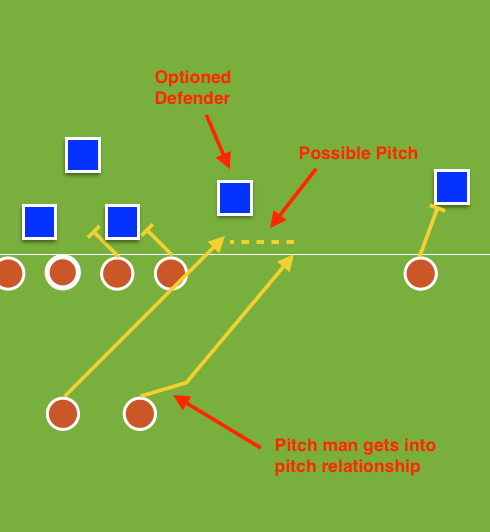
Speed Option 1In any of the option variations there are three moving parts.  First, there is a ball carrier.  Second, there is another potential ball carrier, either a pitch man or a running back able to take the handoff.  Third, there is a defender who is being optioned.

The option is designed so that no matter what the optioned defender does he is wrong.  If he takes the quarterback then the quarterback pitches the ball.  If the defender covers the pitch man, the quarterback will keep the ball.  Implicit in this reasoning is the assumption that the defender will make a choice.  Given his druthers the defender won’t choose at all.  He’ll string the play along and wait for other defenders to come help make the play.

He cannot be allowed to do this, if the option is to be successful.  It is the quarterback’s job to ensure that the defender makes a choice.  How does the quarterback do this?  He forces the choice by attacking the defender.  He must aggressively, quickly and decisively run at the defender.  If the defender is still there when he gets there, the QB pitches the ball.  If not, keep running.

So many quarterbacks are running this so poorly it seems that there must be some coaching deficiencies.  Maybe there are; maybe there aren’t.  Perhaps this skill is difficult to fully internalize unless you spend lots of practice time with it.  That makes more sense.  Whatever the reason, the problem is prevalent in college football.Speed Option

The mistake quarterbacks are making is not being decisive.  They are running generally where the defender is, and then they are slow in making a decision to pitch or keep.  That doesn’t work.  They must be fast and decisive.  They are slow, it appears, because they are thinking too much.  They are in a position where a decision must be made immediately, and it is being made glacially.

The key to making this decision rapidly, other than practice until mastery, is to teach the quarterback the right mindset.  He must be thinking that he is doing one thing unless.  He has to be in an either/or mindset.  “I’m running the ball unless that defender makes me pitch.”  That’s the mindset.  The quarterback is going to run at the defender and turn up, unless he has to pitch.

Watch the speed option when it works and when it doesn’t.  What is the quarterback doing?  Is he being decisive?  Is he attacking and deciding or is he being slow?  This decision and the speed with which it is made will make or break the play.  Done properly, the play is great; done poorly you might as well punt.

Posted in Concepts, Schemes | Tagged , | Comments Off on How (not) To Run the Option

ACC Strong, indeed

Before the season we all knew that the ACC was Florida State, Clemson and 12 also-rans.  Little has happened on the field to change that, but some people want to imply that the conference is strong, resurgent and ready to compete with the big boys.

Kanell tweet

The Kanell tweet is absolutely true, but the implication that the conference is impressive or that it is filled with good teams is absurd.  The ACC remains a borderline power conference.  This season they are 33-15 out of conference, but only 4-10 against other power five conferences.  Both records are the worst among Power Five conferences.

To believe that the ACC is comparable to other power conferences, one must believe that Duke, North Carolina and Pitt, three one loss teams, are worthy competitors.  Nothing that has happened on the field should make you think that.  Duke and Pitt have quality losses, if such a thing exists, in losing to Northwestern and Iowa.  North Carolina lost a head shaker to South Carolina.  That alone should remove them from the conversation, but one game does not a season make.
It’s not about who you lose to, it’s about who you have beaten.  Here the resumes of these pretenders are transparently thin.  Pitt’s best win out of conference is at Akron, 24-7.  In conference, it’s a toss up between Virginia Tech or Georgia Tech.  That’s not the resume of a contender.  Duke’s resume is similarly lacking.  Out of conference they’ve beaten Tulane, North Carolina Central and Miami.  In conference they also built their record on the backs of wins against the Techs.  North Carolina hasn’t gotten to beat Virginia Tech yet, but their most impressive win is Big Ten power Illinois.

North Carolina’s win over Illinois is far and away the most impressive for these three would be contenders.  Why is this game so much more impressive than the other wins?  The win over Illinois is the only win over a FBS team with a winning record.  North Carolina A&T and North Carolina Central also have winning records, but they are FCS teams.  Meanwhile Pitt has no wins over teams with winning records.

acc-football-logoThe ACC simply doesn’t have the contenders to compare to the other conferences.  Clemson may be a playoff contender, but Florida State doesn’t appear to be.  No other team can legitimately claim Top 25 status, though ACC teams are starting to show up there by virtue of record alone.

Nuance is famously missing from 140 character tweets, but the implication of Kannell and his ilk is clear: the ACC has done something impressive on the football field.  Outside of Clemson that narrative is plainly false, and it is abundantly clear after any cursory glance beyond mere win loss records.  Those records are the products of weak schedules and conference competition so lacking it has more in common with an off week than the games the rest of the nation is playing.

Posted in Opinion | Tagged , , , | Comments Off on ACC Strong, indeed

Key Plays: Georgia Tech v Florida State

Everyone saw the Block Six in the Florida State – Georgia Tech game, but the Seminoles would never have attempted the field goal if the Yellow Jackets hadn’t tied the game on the previous possession.  On that possession it appeared Georgia Tech was finished when they were facing a 4th and 5, but they converted, extended the drive, and eventually won the game.  Here’s how.

Let’s look at the formations first.

Diagram 1

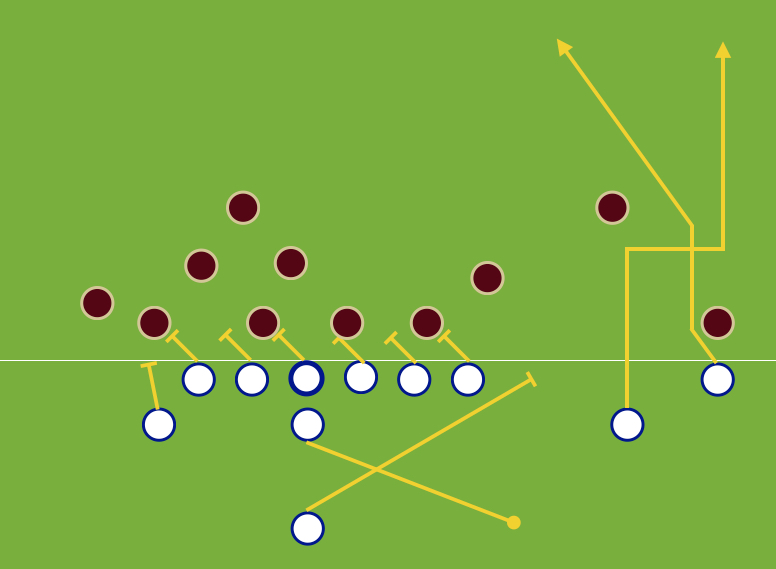
Georgia Tech is in an unconventional formation.  The tackle on the left side of the play is an eligible receiver since he is the last man on the line of scrimmage.  As we’ll see later, Florida State didn’t pick up on this.  Conversely on the right side of the formation the tight end is not eligible because he is covered up by the receiver on the end of the line.

Diagram 2

Florida State responds by playing man coverage and blitzing 6.  The two receivers to the right side of the offensive formation are covered by the defenders across from them, man to man.  The tight end, who is not eligible to receive a pass, is covered by the outside linebacker/nickel back.  The safety has the running back, and the backside corner has the A back (or wingback) on that side.

To defend against the option the backside linebacker rushes around the center of the line to the play side of the formation.  This is a technique to defend against the option because it will be nearly impossible for the quarterback to see this player coming.  If Georgia Tech had run the option and the quarterback made all the proper reads, the ball carrier would still probably encounter this linebacker before making the necessary five yards to gain.  Then we’d be explaining how brilliant this defensive call was.

Diagram 3

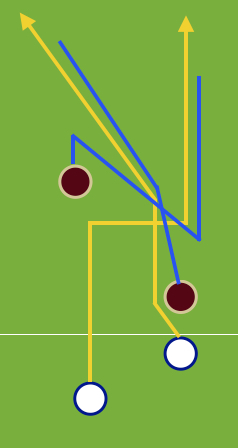
Georgia Tech didn’t run the option.  They ran a two receiver pass play, called the wheel.  On the play the outside receiver runs a post pattern.  By design the post pulls a defender away from the sideline and toward the middle of the field.  Ideally, this is true whether the defense is in a zone or man to man.  In a man to man coverage, like the one FSU ran, the outside defender is supposed to follow the post pattern toward the middle of the field.  In a zone, the defender responsible for the outside zone is not supposed to follow the receiver but often does.

The inside receiver runs a wheel route.  (The combination of these two routes is often called the wheel, too.)  On the wheel route the receiver runs up the field and cuts toward the sideline.  He then makes a second cut vertically down the field.  In man to man coverage, it is difficult for the defender to stay with the receiver through multiple cuts.  Against a zone, the double cut conceals the ultimate destination of the play, which can lull deeper defenders into following other routes rather than staying in their zone.

Diagram 4

The play worked exactly as it was designed.  The corner back covering the post pattern covered his man and ran toward the middle of the field.  The safety covering the slot receiver had to respect the beginning of the wheel route.  Since Tech only needed 5 yards for a first down the safety had to defend the first cut.  When he did the receiver cut again, this time vertically.  This second cut created the separation that allowed him to be so open.  Without any over the top coverage help available the safety was beat.  A good throw later Georgia Tech was in field goal range.

Florida State didn’t do much wrong here.  This isn’t a case of pointing and laughing at a bad call.  The defensive call was solid and appropriate for the situation.  It was an aggressive call to not have any defenders in deep zones, but GT only needed five yards for a first down.

The technique played by the safety wasn’t bad at all.  Obviously it could have been a bit better, but it would be very difficult to be in position to defend a 5 yard out route and the wheel route that was run.  This play was successful because it was a great call at the right time and was well executed.  Although the play probably would have worked against a zone as well, it is ideally suited for the man to man coverage it defeated.

Posted in Concepts, News, Schemes | Tagged , , , | Comments Off on Key Plays: Georgia Tech v Florida State

What We Learned: Week 8

Think Twice Before Kicking that FG.  For years we’ve all known that in a tie game there’s virtually no downside to kicking a field goal as time expires.  If you make it, you win; if you don’t, there’s overtime. Auburn’s Kick Six was a warning that there might be a downside to game ending field goals.  Saturday’s pair of kick sixes were confirmation that these plays are going to continue to happen, and kicking teams better do something about it.

These returns are no longer once in a lifetime events.  They will now be planned and drawn up.  Kick block teams are going to set up returns like punt returns, and more touchdowns are going to be scored.  In addition to protecting the field goal attempt, teams will now have to have a coverage scheme in place to stop these touchdowns.  It won’t be easy for such a tightly packed group to cover, but woe be unto the team who ignores the possibility.  Trading out better blockers for more athletic players who can tackle may be the price of field goal attempts.

You have to take Clemson seriously now.  A 58-0 road win over a Miami team who appeared to be completely competent was enough to vault the Tigers to #3 in the AP poll.  It’s tempting to discount the margin of victory and dismiss the game as another win over another unranked team, but this wasn’t a 31-0 beating; 58-0 should never happen in conference, but it did.

2000px-Clemson_University_Tiger_Paw_logo.svgClemson seems to be answering their questions in a big way.  Would the offense still be able to produce without Chad Morris? Yes.  Will the defense be able to replace their talent and compete? Yes.  Will the Tigers be able to avoid dropping an inexplicable game that has plagued the program in years past?  So far, yes.

The Tigers will still have a strength of schedule debate to win.  The Notre Dame win continues to look strong, but the Florida State loss wasn’t ideal.  As it appears now the Tigers only have two ranked teams on their schedule.  Down years by Louisville and South Carolina haven’t helped, but a ranked team could come out of the Coastal division to buoy that schedule.  Without some unexpected results, the Tigers schedule will be their Achilles Heel, but if they keep winning 58-0, they make a powerful counter argument.

Poor, poor Nebraska.  How many close games are the Cornhuskers going to lose?  It must seem like groundhog day in Lincoln.  The season opened with a Hail Mary loss to BYU.  Sandwiched around some wins are losses at Miami by three, at Illinois by one, against Wisconsin by two and against Northwestern by two.  Nebraska is a Hail Mary and 8 points away from being 8-0.  That’s a tough season to endure, but remember that when the Cornhuskers upset Michigan State or Iowa in November.

Missouri’s reign is over.  Every year the Missouri Tigers are written off as also rans in the SEC East, but the last two years they’ve won the division.  Early season losses or ugly wins usually serve as confirmation of the dismissive opinions, but conference wins put the Tigers in Atlanta.  That won’t happen this year.

The Tigers appeared to be following their typical trajectory.  They had an ugly win over UConn at home.  They did beat South Carolina, but losses to Georgia and now Vanderbilt have ended any hope for winning the East.  In fact, sitting at 4-4, the Tigers are no lock to make a bowl game.

Kentucky is also finished in the East.  That’s not exactly the most unexpected TpSKg_3Lheadline of the week, but there was hope in Lexington that this year would be different.  Strong recruiting classes formed the basis of optimism and an early win over South Carolina stoked the fire.  A close loss against Florida and a win over defending East champ Missouri continued to fuel the resurgence.  A back breaking loss to Auburn brought those hopes back to earth.  The momentum was all lost by the time Mississippi State left the field on Saturday with a blowout win.  As long as the Wildcats can refocus, they should still finish 7-5 and go to a bowl game, but for a while it seemed like more was possible.  Maybe next year.

Posted in News, Opinion | Tagged , , , , , , , , , | Comments Off on What We Learned: Week 8